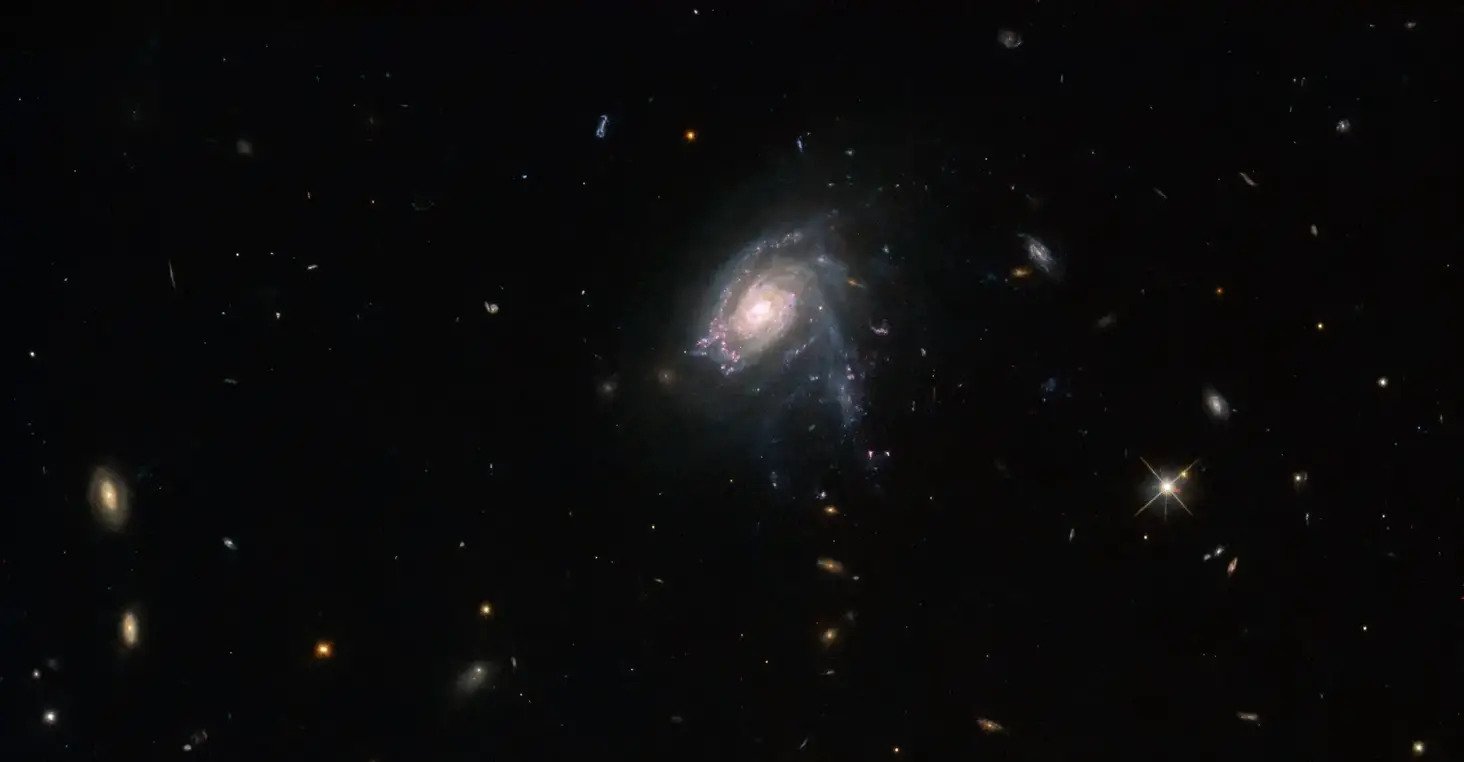
Hubble Space Telescope Spots a Ghostly Galactic Jellyfish
-
 Loading...
 - Auja Brunner
- 02 May 2023
- 74 Views
- 0 Like
- 0 Comment
The Hubble Space Telescope has captured detailed images of the jellyfish galaxy JO175, over 650 million light-years away. Named for their star-forming tendrils, recent research suggests that star formation in these galaxies is similar to the process in standard galactic discs.
The jellyfish galaxy JO175 appears to hang suspended in this image from the NASA/ESA Hubble Space Telescope. This galaxy lies over 650 million light-years from Earth in the appropriately-named constellation Telescopium, and was captured in crystal-clear detail by Hubble’s Wide Field Camera 3. A handful of more distant galaxies are lurking throughout the scene, and a bright four-pointed star lies to the lower right side.
Jellyfish galaxies get their unusual name from the tendrils of star-forming gas and dust that trail behind them, just like the tentacles of a jellyfish. These bright tendrils contain clumps of star formation and give jellyfish galaxies a particularly striking appearance. Unlike their ocean-dwelling namesakes, jellyfish galaxies make their homes in galaxy clusters, and the pressure of the tenuous superheated plasma that permeates these galaxy clusters is what draws out the jellyfish galaxies’ distinctive tendrils. Read More..