Prime vs Zoom Lenses: A Beginner's Guide
-
 Loading...
 - Chantale Ayissi
- 25 Aug 2022
- 77 Views
- 0 Like
- 0 Comment
In your photography adventure, you will most likely buy both a prime lens and a zoom lens at some point. If you are a beginning photographer looking to upgrade to a new lens, you are probably facing the decision of whether to choose a prime or a zoom. Which type should you get and what’s the difference?
The Pros and Cons of Zoom Lenses
When I started in photography, I purchased a camera kit with a couple of zoom lenses. These starter lenses allowed me to practice with the camera and its settings. My kit came with both an 18-55mm and a 55-250mm lens.
Pro: Versatility
These zoom lenses offered a broad range to shoot with. I was able to achieve wide or close-up shots by rotating the zoom ring on the lens to get the desired frame. By design, zoom lenses allow you to take a closer or farther composition of your subject without having to walk up to or away from it. To get the desired frame of your image, you can dial in or out to fine-tune what you want in the picture.
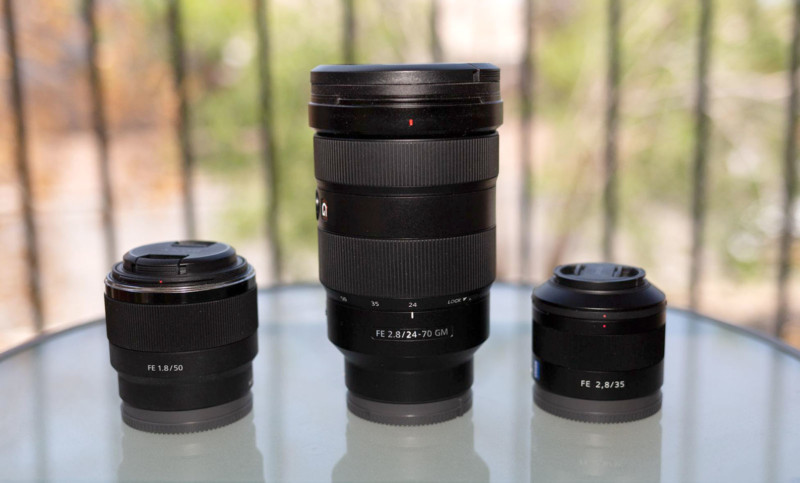
Zoom lenses come in a variety of ranges with the 24-70mm and the 70-200mm being the most common. If you want the holy trinity of lenses, you would add an ultra-wide lens ranging from 16-35mm. Zoom lenses offer the best range for taking different types of photos as you can easily frame your shot by zooming in or out.
Being so versatile, zoom lenses are great for travel and general use. A majority of photographers you see in public use some type of zoom lens, often either a 24-70mm or a 24-105mm lens. Both are great lenses and give the best of both worlds. The 24-70mm usually has its widest aperture at f/2.8 while the 24-105mm is usually not as fast and has its widest aperture at f/4.
Remember: the wider the aperture, the shallower the depth of field. Shallow depth of fields produce blurry backgrounds that create separation between the subject and the background. Either of these can quickly become your favorite lens.
Pro: A Lighter Camera Bag
The flexibility of zoom lenses means you can carry fewer lenses in your camera bag to cover the same focal range. Instead of having to carry a 24mm, 50mm, and 85mm lens, you can just carry one 24-70mm lens (sacrificing a little reach on the telephoto end). A 24-105mm is even more versatile, giving you nearly the equivalent of adding a 105mm lens to your kit.
What’s more, zoom lenses will allow you to capture any focal length in their entire range, whereas carrying prime lenses will force you to give up the focal lengths between what your prime lenses capture.
Con: Image Quality
There are drawbacks to zoom lenses. First, they can have worse image quality, especially when considering lower-end lenses — in the world of modern professional lenses, there is minimal to no image quality gap between zooms and primes.
Zoom lenses have more complexity and moving parts, and these attributes usually come with poorer image quality when compared to the simpler design of prime lenses in the same focal range.
Con: Worse for Bokeh
Zoom lenses are also generally not as fast as primes. By fast we mean the maximum aperture is not as large, usually topping off at f/2.8. That’s not to say that you can’t obtain creamy bokeh backgrounds. It just means they are not as good as prime lenses in capturing photos with a razor-thin depth-of-field and extreme background blur compared to a prime lens with a larger maximum aperture. Read More...