Complex learned social behavior discovered in bee's 'waggle dance'
-
 Loading...
 - Theo Kennedy
- 09 Mar 2023
- 65 Views
- 0 Like
- 0 Comment
Passing down shared knowledge from one generation to the next is a hallmark of culture and allows animals to rapidly adapt to a changing environment.
While widely evident in species ranging from human infants to naked mole rats or fledgling songbirds, early social learning has now been documented in insects.
Publishing in the journal Science, a University of California San Diego researcher and his colleagues uncovered evidence that social learning is fundamental for honey bees. Professor James Nieh of the School of Biological Sciences and his collaborators discovered that the "waggle dance," which signals the location of critical resources to nestmates through an intricate series of motions, is improved by learning and can be culturally transmitted. The study demonstrates the importance of early social signal learning in one of the most complex known examples of non-human spatial referential communication.
"We are beginning to understand that, like us, animals can pass down information important for their survival through communities and families. Our new research shows that we can now extend such social learning to include insects," said Nieh, a professor in the Department of Ecology, Behavior and Evolution.
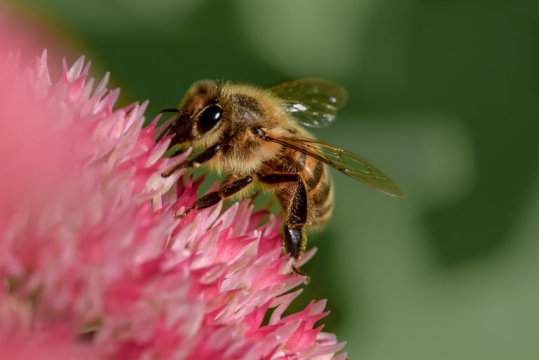
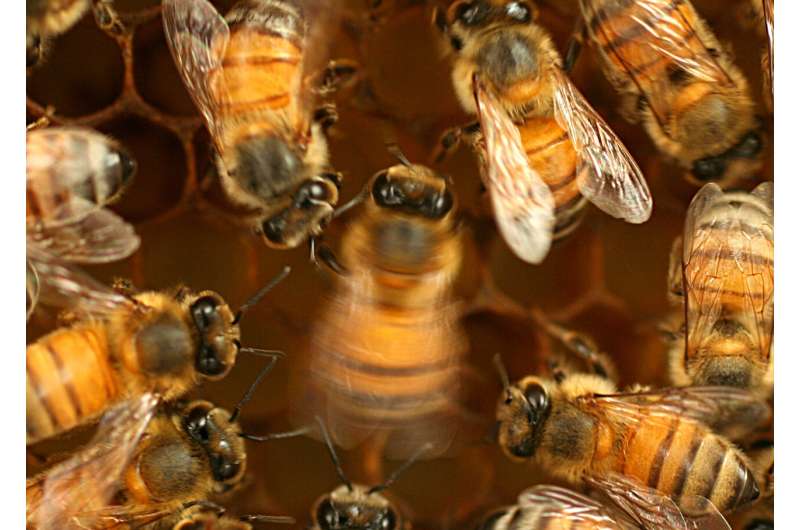
A social insect with a highly organized community structure, honey bees help ensure the survival of their colonies by communicating the location of food sources to one another through a waggle dance in which bees circle around in figure-eight patterns while waggling their bodies during the central part of the dance. Read More…