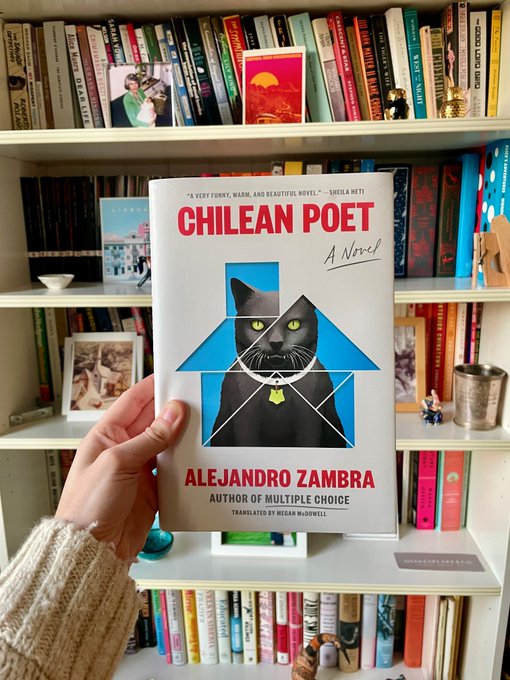
Book Review: ‘Chilean Poet’ by Alejandro Zambra, Translated by Megan McDowell
-
 Loading...
 - Louis Robert
- 07 Jun 2023
- 64 Views
- 0 Like
- 0 Comment
Unearthing a fresh wordsmith is an unparalleled delight in the realm of literature. Much like opening a box of chocolates made famous by Forrest Gump, the anticipation of how an unfamiliar author's book will resonate, if at all, is unpredictable. Will the book be a delectable treat or a disappointing letdown? My encounter with Alejandro Zambra occurred during an exploratory visit to the Book Den in Santa Barbara. The title "Chilean Poet" caught my eye, immediately evoking thoughts of Pablo Neruda, the sole Chilean poet I was vaguely familiar with. However, my literary horizons expanded beyond Neruda's realm, all thanks to Zambra—a Chilean poet, short-story writer, and novelist of repute. Megan McDowell, a National Book Award-winning translator, expertly rendered Zambra's work into English.
Initially, the novel introduces a trio of characters: Gonzalo, an aspiring poet and academic; Carla, an upper-middle-class woman; and her son, Vicente. Gonzalo and Carla first cross paths as teenagers, engaging in secretive encounters beneath a blanket on Carla's couch. Gonzalo, the nerdy and inexperienced one, is completely infatuated, while Carla remains cautious, content with their clandestine escapades, convinced they will never lead to anything substantial.
Over time, they go their separate ways, only to chance upon each other in a bar years later. Gonzalo has become a teacher, while Carla has married, given birth to Vicente, and experienced divorce. They rekindle their relationship and form a family. Gonzalo embraces his role as a stepfather to six-year-old Vicente, despite Carla's somewhat domineering nature. While family life presents its challenges, including the uncertainties of being a step-parent, their relationship endures for several years, persisting even after Carla suffers a miscarriage. However, when Gonzalo accepts a teaching position in New York without prior discussion, they part ways once more, this time for good.
When we encounter Vicente again, he is now an 18-year-old young man, adrift and in search of his path. He possesses a love for poetry and gravitates towards a social circle of like-minded individuals. Vicente rarely responds to the occasional messages from Gonzalo. However, when he coincidentally meets Pru, a blonde American freelance writer twelve years his senior, who finds herself at loose ends due to a difficult breakup in New York, Vicente convinces her to delve into the world of Chilean poets through her writing. Vicente provides Pru with introductions that propel her forward on this new literary journey. She conducts interviews with both renowned and obscure poets, male and female, discovering that "being a Chilean poet is like being a Peruvian chef or a Brazilian soccer player or a Venezuelan model," as one poet aptly describes.
Pru finds herself bewildered by the privileged position occupied by poets in Chilean society. Some poets surpass the fame of fiction writers, while others are fiercely competitive and opinionated, often engaging in catty behavior. A select few exude qualities suitable for leading a sect or pursuing political office. They are eloquent speakers, considering themselves harbingers of revolution or salvation. Similar to businesspeople exchanging cards, these poets readily offer Pru their books. The world of Chilean poets is marginally less stratified than Chilean society at large, yet it remains tainted by sexism.
In the final section of the novel, Gonzalo and Vicente reunite. They convene to discuss poetry, including the sole collection of poems Gonzalo published years ago, dedicated to Carla and Vicente. Their relationship has transformed significantly. Although Gonzalo has permanently returned to Santiago, he has ceased writing and no longer considers himself a poet. Instead, he takes a keen interest in Vicente's poems, encouraging him to share his work. Their meeting evolves into an extensive evening of bar-hopping and profound conversations, wherein they both realize that this may be the most fulfilling connection they can expect from each other. Poetry binds them more strongly than the years they spent living under the same roof.
The novel's conclusion is unexpectedly clever, leaving a lasting impression as the ideal way to bring this heartwarming and captivating read to a close.