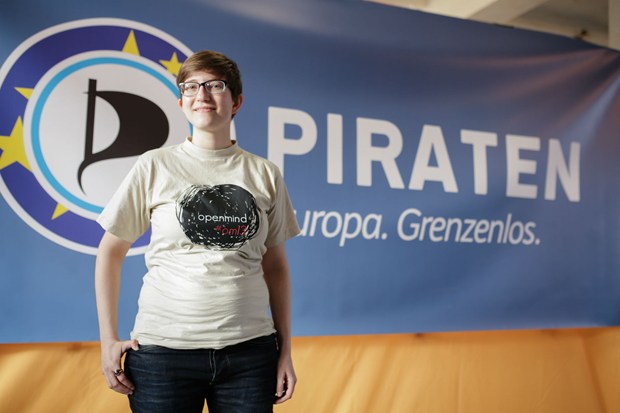
A German pirate just saved our right to take public selfies
-
 Loading...
 - J. Oliveira
- 14 Jul 2020
- 757 Views
- 0 Like
- 0 Comment
The European Parliament has rejected proposals to place copyright restrictions on photos of public places. The proposals would have forced members of the public to secure permission from architects or rightsholders before sharing selfies taken in front of architectural landmarks on social media.
502 MEPs voted against the proposals -- part of a move to create a resolution streamlining European-wide copyright law -- including the very MEP who first tabled the inclusion, Jean-Marie Cavada.
Our right to take and share architecturally-important selfies (known as the Freedom of Panorama) was saved by Julia Reda, MEP and Germany Pirate Party politician. Reda wrote the original draft the resolution, passed on 9 July, was based upon.
"As a result, most Europeans will continue to be able to post selfies online and view photos of famous buildings on Wikipedia unencumbered by copyright," Reda told WIRED.co.uk. "At the same time, the fact that the attack on freedom of panorama for a time enjoyed the support of a majority demonstrates that many MEPs have yet to fully understand the cultural shift caused by the internet and its consequences for copyright. Much work remains until we have a European copyright framework fit for the digital age."
UK law already protects our right to take photos of public buildings, under the 1911 Copyright Act. But countries including France, Italy and Belgium require photographers and filmmakers to obtain licenses and pay fees to work in public places. Reda points out that those publicly supporting the highly unpopular move to make these kinds of rules European-wide, had mainly been French collection societies making millions from the permissions systems. "A French newspaper, Les Echos, reported yesterday that YouTube in fact does have a contract with a collecting society for such uses in France," Reda says.
This is in line with MEP Cavada's original plan for the proposal -- to target platforms like Wikipedia and Facebook, not their end users. End users would, however, have been legally vulnerable since every time you upload a photo to Facebook, for instance, you grant it the right to commercially use that photo.

Views like this could have been a thing of the past. Okay. Maybe there are some drawbacks to the freedom-saving vote...Shutterstock
"This amendment would be disastrous," Michael Maggs, chair of Wikimedia UK, said ahead of the vote. "Many citizens use Facebook, Tumblr and other commercial social media sites, and uploads to such sites would put photographers at legal risk, even if no money changes hands. Non-commercial is not the same as non-profit, and large numbers of educational, charity and academic sites would be affected, including Wikipedia." He warned that if such a clause were to pass, it could put international filmmakers off working in Europe.
That such a proposal got this far, seems incredible. Reda tells WIRED.co.uk that the likely reason for the Legal Affairs Committee passing the proposal, leading to the vote, will not be that it was "carefully evaluated" and agreed upon. Instead: "[MEPs] simply extended to this amendment the same attitude and convictions they apply to all copyright reform issues" -- that more copyright protection, will always be a good thing.
Reda does not think the effort by a minority to alter the Freedom of Panorama could rear its head again, saying: "That's hard to imagine after the public outcry and the decisive vote: only 40 MEPs voted to keep the call for a restriction, 502 against -- including, in the end, even Mr Cavada himself." The UK's Royal Institute of British Architects (RIBA) publicly stated it wasagainst the proposals in June, warning they could have "negative implications, and represent a potentially damaging restriction of the debate about architecture and public space"; while a Change.org petition against the changes racked up half a million supporters before the vote.
Reda does, however, hope to push for the Freedom of Panorama to be part of Europe's copyright "harmonisation" later in the year -- it didn't make it that far in yesterday's vote.
Other good news from yesterday's vote, and more successes for Reda, include the voting down of an amendment brought by German MEPs that would have seen the introduction of a Europe-wide "snippet tax", which has seen Google News stop publishing German news stories to avoid paying a levy on them. There was also a call to stop further geoblocking, which Reda says would have prevented "cultural minorities from accessing content in their language across borders", and "a call to enable e-lending and digitisation for libraries and text and data mining for scientists". Making it all in all a good day for creative freedoms.
It's definitely not time to rest, though, warned Reda, indicating to WIRED.co.uk that the concerning anti-internet company culture shows no sign of slowing -- and could ultimately backfire on Europe.
"One of the remaining worrying points in the report is a very negative outlook on internet platforms inserted by MEPs," she says. "Even the freedom of panorama restriction proposal can be seen in this context -- the conviction that online services are parasitic foreigners unfairly profiting off 'our' culture. The Commission has also announced plans to review the role of platforms as part of their digital single market strategy.
"An attempt seems to be mounting to increase the liability of social networks, search engines, apps etc. for copyright infringement committed by their users. This is dangerous, as it risks privatising law enforcement, incentivises service providers to actively screen user content which is both a privacy concern and can lead to overblocking when providers decide to err on the side of caution. The end result may be a concentration of the market to a few large intermediaries who can afford to put in place complicated monitoring systems -- thus increasing, rather than limiting, the dominance of today's big players."