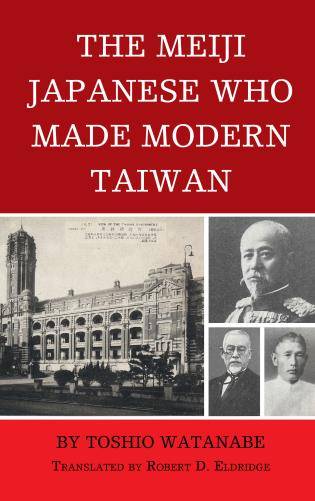
Toshio Watanabe lifts the veil on the bureaucrats who developed Taiwan
-
 Loading...
 - Aiguo Wang
- 14 Jun 2022
- 266 Views
- 0 Like
- 0 Comment
Japan became a colonial power in 1895, at the end of the first Sino-Japanese war. This, however, did not happen by design: Tokyo had gone to war with Beijing the previous year in order to wipe out Chinese influence in Korea, not to acquire new territory.
Early in the conflict, however, Japan scored a series of decisive victories that boosted the confidence of its leaders. Before long, they were asking for a large indemnity as well as the ceding of Taiwan and the neighboring archipelago of Penghu. They even pushed for control of the Liaodong Peninsula on the Chinese mainland, but that was a bridge too far for Russia, Germany and France, who feared for their interests in the Middle Kingdom. They forced Tokyo to pare back its ambition and made it clear it would have to be content with Taiwan and Penghu.
Having swallowed its pride, Japan began asserting its authority on its new possessions. This was no easy task. While some members of the Taiwanese elite were willing to collaborate, others were itching for a fight. To pacify the island, Tokyo had to deploy 50,000 soldiers, a full third of its army’s strength, on a five-month combat mission. Even after that, spotty resistance continued for a number of years. All in all, it was a bloody and costly affair — so much so that, in 1897, some Japanese politicians mused about selling Taiwan to the French.
The appointment of Kodama Gentaro (1852-1906) as governor general in 1898 offered hope for improved stability. A career military officer and brilliant logistician, Kodama had a knack for transforming ideas into practical policy. He also knew how to surround himself with talent. His most inspired decision was to pick Goto Shinpei (1857-1929), a German-trained doctor and creative administrator — and later a Cabinet minister and mayor of Tokyo — to head the colonial bureaucracy.
It is no hyperbole to say that Kodama and Goto transformed Taiwan. Their priority was to kick-start the economy so they began by concocting a bold development program. They completed the railway linking Taipei to the southern city of Kaohsiung, expanded capacity at key ports and launched an island-wide land survey to boost tax collection. They also introduced measures to decrease opium consumption, sponsored an extensive census of the population and established a central bank. Of note, it was under their leadership that planning for a new building to host the office of the governor general was initiated. Although it was completed only in 1919, it became a Taipei landmark — it still stands and now hosts the office of the President. When the pair took over in 1898, the colony was a drain on the finances of the Japanese central government. Around the time they parted ways in the mid-1900s, Taiwan was financially independent.

While the achievements of Kodama and Goto are well-known, at least among historians, the contribution of lower-ranking officials has largely been overlooked. That is a shame. Not all of them were remarkable administrators, but many were and, in several cases, the impact of their work is still felt today.
A good part of Toshio Watanabe’s slim volume is dedicated to these individuals. His narrative is detailed and highly instructive, but, alas, it largely ignores the perspective of native Taiwanese. Readers thus get a clear understanding of what colonial administrators were trying to achieve, but are largely left in the dark as to what the local population thought. Frequent typos — and even a few factual errors — are distracting, too. Nevertheless, the author should be commended for introducing this poorly known story to English speakers.
A key protagonist was Eikichi Iso (1886-1972), an agricultural engineer from Sendai University who arrived in Taiwan in 1912. For decades, he labored to improve rice production in terms of yield, nutritional value and even taste — the better to ensure it would be pleasing to Japanese palates. After breeding countless strands and working in close collaboration with another engineer, Megumu Suenaga (1886-1939), he successfully created a new variety of rice, “hÅraimai,” also known as “ponlaimai,” which is still the main type consumed in Taiwan today. At the end of the war, Iso decided to stay in Taiwan. The building at National Taiwan University where he continued his research can still be visited today.
Yoichi Hatta (1886-1942) is somewhat better known. A Kanazawa native, he trained as a civil engineer before moving to Taiwan. In the 1920s, he designed a massive irrigation system — canals, reservoirs, aqueducts, tunnels and even a dam — that greatly improved agricultural output in the southern Chianan region. In fact, much of that infrastructure is still in use today and, in 2011, the Yoichi Hatta Memorial Park was built to commemorate his work. Read More...