Tips for Photographing a Lunar Eclipse
-
 Loading...
 - Oliver Johnston
- 14 Jul 2022
- 125 Views
- 0 Like
- 0 Comment
Before you venture out to photograph your first lunar eclipse, you should get some practice taking photos of the moon. If lunar photography is varsity-level stuff, lunar eclipse photography is all-pro. There are some unique challenges to the art, and great ways to get creative results, but the basics of lunar photography apply. Unlike solar eclipse photography, you do not need gear to protect your cameras, lenses, or eyes. However, like solar eclipse photography, having the right accessories may help you get the best images.
If you are new to lunar photography and you missed the link above, or did not get the hint, pause here and head to this link with some tips for photographing the moon.
It should be known that you can take a "casual" and successful photo of a lunar eclipse with just about any camera, including your smartphone. But, if you want the know-how to grab a truly epic keeper, keep reading.
One personal note before we dive in: I have photographed several lunar eclipses and I have not always gotten the best results. Honestly and luckily, I get better at photographing lunar eclipses every time I do it and I am going to pass on the lessons I have learned so that you can, hopefully, get good results your first time out!

3 Varieties of Lunar Eclipse
The Earth orbits the sun, and the moon orbits the Earth every 27.32 Earth days (the phase cycle is 29.53 Earth days). A solar eclipse occurs when our moon passes directly between the Earth and the sun in its orbit. A lunar eclipse is the opposite; the moon passes through the Earth's shadow as it orbits the planet on the opposite side of the sun. Because the moon's orbit is offset from Earth (5º), we do not get a lunar eclipse during every full moon. It is this same tilted orbit that keeps solar eclipses rare, as well.

Depending on what portion of the Earth's shadow the moon passes through determines the type of lunar eclipse we experience. If the moon passes through the penumbral (partial) region of the shadow, we get a penumbral lunar eclipse. Sometimes, the effects of the darkening of the full moon during a penumbral eclipse are so slight that you might not notice the eclipse. If part of the moon, but not all, passes through the umbral (inner) shadow, you get a partial lunar eclipse. And, finally, when the entire moon passes into the umbral shadow, we witness a total lunar eclipse.
And, opposite from the solar eclipse that happens only during the new moon phase, the lunar eclipse only happens on full moon nights.

Why is the total lunar eclipse moon a red moon?
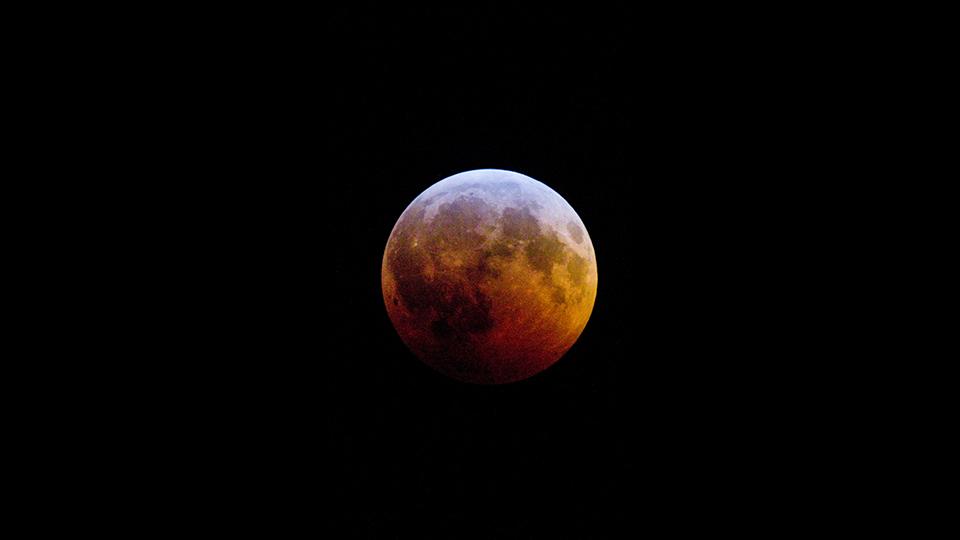
During totality, the monochromatic moon will appear red because our own atmosphere acts like a colored photographic filter by bending red sunlight into the Earth's shadow and filtering out blue light. This is called Rayleigh scattering and is the same phenomenon that causes the deep red sunrises and sunsets that get all the Instagram likes. Also—fun fact—the next time a young someone asks you, "Why is the sky blue?" you can answer: Rayleigh scattering.

How bright is a lunar eclipse?
Not all lunar eclipses are created equal. Due to atmospherics (humidity, clouds, dust, volcanic ash, pollution, etc.) and the moon's relative size and position within the Earth's shadow during the eclipse, you can get an eclipse that varies in its red hue and you can also witness blue banding at the edge of the eclipse. French astronomer André-Louis Danjon created the Danjon Scale, with five values total lunar eclipse of brightness:
L=0 — Darkest. Moon nearly invisible.
L=1 — Dark red/brown eclipse. Lunar details are difficult to make out.
L=2 — Orange/brown color with darker center. Possible bluish color at shadow's edge.
L=3 — Bright red/orange moon. Darker center and very bright border.
L=4 — Brightest. A very bright orange eclipse.
 ·
·