The many shades of Sadequain
-
 Loading...
 - Mukta Tatwadi
- 27 Jun 2022
- 155 Views
- 0 Like
- 0 Comment
Born on June 30, 1930, Sadequain (1930–1987) would have been ninety-two this year.
Art and culture, ae the identity of a nation. By all measures, Sadequain was the finest ambassador of the nation’s identity. He represented a confluence of the traditions started by Picasso, Michelangelo, Omar Khayyam and Yakoot, the calligrapher. His work was innovative and difficult to duplicate.
Sadequain was a polymath and recognised on all five continents even before the advent of social media or television. A Khaleej Times article carried on June 20, 1980 described him as a mystic artist from Pakistan “who has become a legend in his own time” and was “endowed with divine inspiration.”
Sadequain is the only Pakistani to have been awarded four awards in arts namely, the Nishan-i-Imtiaz, the Sitara-i-Imtiaz, the Tamgha-i-Imtiaz and the Pride of Performance. He was a celebrity in his lifetime. In a December 2009 article in a Pakistani newspaper, a prominent art personality was quoted as saying that after a few decades or so, not many people (in Pakistan) would remember Sadequain because by then, all traces of his work would be erased. This sounds like a a harsh statement about Sadequain, but is in fact a comment on the state of affairs in the country.
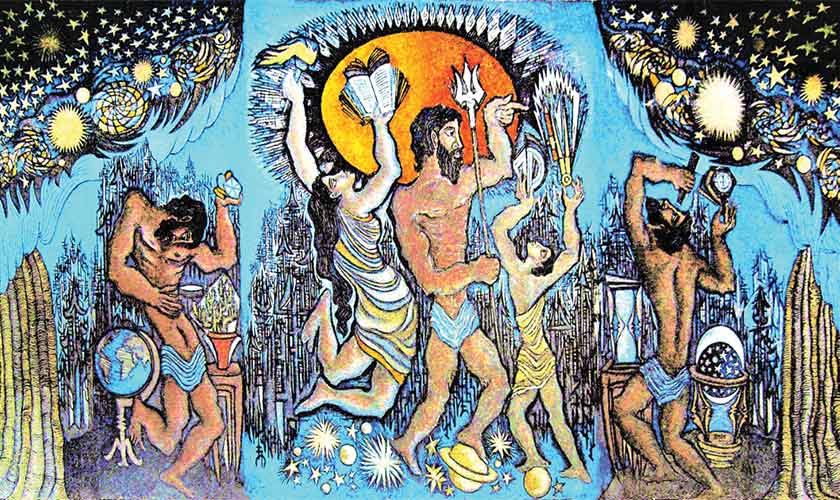
Thankfully, Sadequain has left behind an extensive oeuvre spread all over the world. Even if a fraction of it is preserved diligently, it will be more than most artists’ lifetime’s work. His monumental murals are unparalleled. Sadequain painted more than 45 murals from 1950s to 1980s. The murals are his tributes to scholars, writers, scientists and hard-working men and women of a society. His celebrated characters are not kings and queens, the rich or the powerful, but the visionaries and the workers.
Some of Sadequain’s greatest murals adorn the museum at the State Bank of Pakistan, the Power House at Mangla Dam, the main entrance hall to the Lahore Museum and its Islamic Gallery, the University of the Punjab, the Punjab Public Library, the Frere Hall ceiling in Karachi, the Aligarh Muslim University in India, Urdu Ghar in Hyderabad, India, Banaras Hindu University in India, National Geophysical Research Institute of India and the Abu Dhabi Power House. Placed in tandem, his work at the Hamdard Research Institute of Islamic Studies in Delhi alone will stretch 700 feet; placed side-by-side, it will cover more than 3,000 square feet.
Sadequain’s paintings based on the poetry of Ghalib, Iqbal and Faiz represent a confluence of the most extraordinary talent of the arts and Urdu literature. These masterpieces are one of the cornerstones of his portfolio. They represent an exalted state that transcends the artist and the viewer. The extraordinary collection of over 100 interpretive paintings and two large murals based on the visions of the greatest poets of Urdu language remind us that resisting the lure of material entrapments can raise mankind to an exalted state. This collection of paintings constitutes a singular achievement by an artist.
Sadequain was not a painter of objects; he was a painter of ideas. His paintings mirrored his own words when he said, “People ask why I don’t paint flowers, butterflies and landscapes. I tell them that I seek the truth; I am after reality. I am not inspired by someone posing against the backdrop of roses-in-a-vase or pink curtains. What inspires me is a person who has gone hungry for hours and is struggling for survival. The expression that lights his face at the end of the day when he has finally found some scraps is what touches me. I am a painter of the expression of reality.”
In as much as art imitates life, its relationship with the society defines the quintessential forms of human existence. It was these forms that Sadequain explored. In practice, Sadequain’s compositions performed magically with the complexity of a well-orchestrated symphony. They represented poetry of colour, harmony of rhythm and the power of a tempest. French newspaper Le Monde wrote in April 1964, “The multiplicity of Sadequain’s gifts is reminiscent of Picasso.” The newspaper recognised Sadequain’s multi-dimensional genius.
Even a cursory look at Sadequain’s palette alerts one to his immense talent. Gazing at his extraordinary imagery, we are transported to the core of our subliminal state. The visual journey through a blissful odyssey is an unadulterated experience of heightened awareness as our senses process these mystic images. Read More…