The final results of the Majorana collaboration's search for neutrinoless double-beta decay
-
 Loading...
 - Stevens Harvey
- 03 Mar 2023
- 56 Views
- 0 Like
- 0 Comment
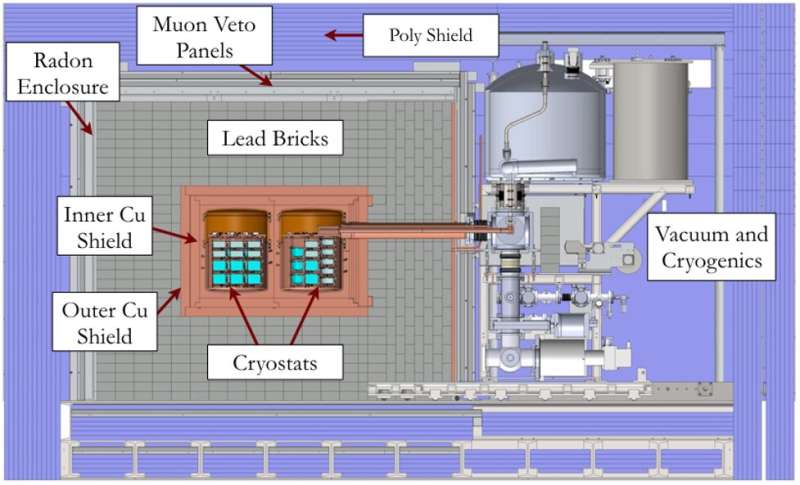
For more than half a decade, the Majorana Collaboration, a large consortium of researchers from different universities worldwide, have been trying to observe neutrinoless double-beta decay, one of the rarest forms of radioactive decay. This was done using the Majorana Demonstrator, a detector located at the Sanford Underground Research Facility in South Dakota, a laboratory that is almost 1 mile underground.
This large-scale experiment employed 30 kg of pure germanium (Ge) crystals, enclosed in deep-freeze cryostat modules and protected by the laboratory's outer protective lead shield. Its final results, published in a recent paper published in PRL, set new constraints on the neutrinoless double-beta decay (0νββ) of 76Ge.
"The primary objective of this 30-kg experiment was to establish the feasibility for a much larger experiment using germanium (Ge) detectors for neutrinoless double beta decay (0νββ)," Steve Elliott, one of the researchers who carried out the study, told Phys.org. "Previous work had demonstrated the viability of using Ge detectors for this research. This project was funded by the DOE and NSF after concepts were established using Laboratory Directed Research and Development (LDRD) funds from a number of national laboratories."
Neutrinoless double beta decay (0νββ) is a predicted form of radioactive decay that, if it exists, would require special characteristics of neutrinos, including having a mass and a Majorana nature. While neutrinos have already been found to have a mass, the experimental observation of this decay would ultimately also prove that they are Majorana particles, which essentially means that they also act as their own antiparticles.
"If the neutrino is a Majorana particle, it leads to theories that can motivate the preponderance of matter over anti-matter in the universe—a necessary condition for life as we know it to exist," Elliott explained. "This decay, if it exists, would be extremely rare with its half-life being longer than 1026 years (1016 times longer than the age of the universe). Being so rare, any other radiation, from trace impurities in the shield or from cosmic rays, depositing energy in the Ge would mask the signal." Read More…