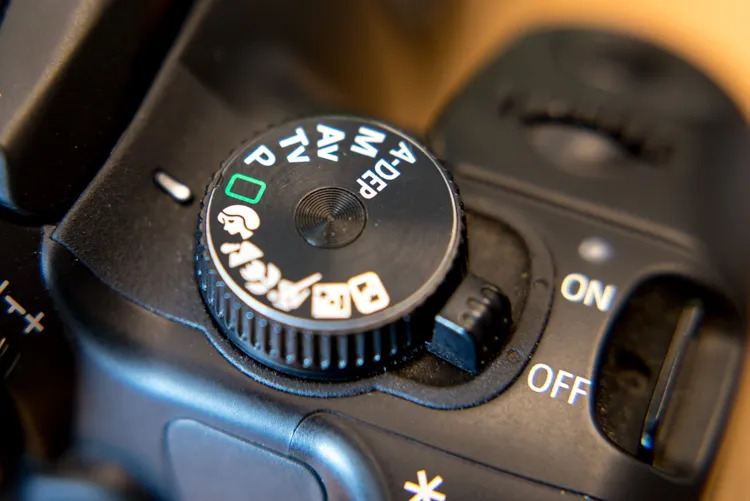
The Camera Mode Dial: A Comprehensive Guide

If you own a DSLR, a mirrorless camera, or even a high-end point-and-shoot model, you’ve probably spent time scrutinizing the camera mode dial.
Here, I’m talking about the circular dial on top of cameras with an array of strange letters: M, Tv (or S), Av (or A), P, and maybe even a U1 or U2 (or C1 or C2). There is also a friendly green option; it may say Auto, or it may simply be represented by a green rectangle.
The default option for most cameras is this green Auto option, which essentially gives the camera complete control over your settings. Auto mode doesn’t do a bad job, but it doesn’t do an especially good job, either. It can lead to poor exposures, unwanted aperture effects, and even blur – so if you want to capture consistently solid shots, I highly recommend familiarizing yourself with (and eventually using) the other modes on the mode dial.
Learning the ins and outs of your mode dial can be somewhat daunting, and those strange letters won’t inspire much confidence for beginners who already feel overwhelmed. But don’t worry! In this article, I walk you through the basic functions of the mode dial one by one, and I explain – using easy-to-understand language – how you can start experimenting with some of your camera’s more advanced settings.
Let’s dive right in.
Auto mode
I mentioned Auto mode above, and it might seem fairly self-explanatory, but I’d like to offer some detail about how it works.
Auto mode instructs your camera to choose the three main settings that govern exposure (aperture, shutter speed, and ISO). In general, your camera will then do whatever it can to make sure the pictures you take are properly exposed (in other words, not too dark nor too bright). It might widen or narrow the aperture, raise or lower the shutter speed, or boost or drop the ISO. If your camera has a flash, it may decide to fire it in order to brighten up a scene that is quite dark (e.g., when you’re shooting indoors or at night).

Auto allows you to take decent photos in a variety of situations. However, your camera cannot read your mind and determine your artistic intentions, which means that it may pick an unwanted aperture, shutter speed, or ISO value. Auto mode can also produce poor exposures when faced with certain subjects scenarios, and that’s where a semi-automatic mode can come in handy. Read More…