Syria war: Eastern Ghouta bombing 'catastrophic'
-
 Loading...
 - MaryKennedy
- 21 Feb 2021
- 901 Views
- 0 Like
- 0 Comment
A doctor working in the Syrian rebel enclave of the Eastern Ghouta says the situation is "catastrophic" - and he believes the international community has abandoned the people living there.
"We don't have anything - no food, no medicine, no shelter," Dr Bassam said.
Activists say 45 people were killed in fresh government air strikes on Wednesday, bringing the total death toll there since Sunday to nearly 300.
The Red Cross is demanding urgent humanitarian access to the region.
The Syrian military says it is trying to liberate the area from terrorists - but it has also been accused of targeting civilians.
The Eastern Ghouta is dominated by the Islamist faction Jaysh al-Islam. But Hayat Tahrir al-Sham, a jihadist alliance led by al-Qaeda's former affiliate in Syria, also has a presence there.
How bad is the situation in the Eastern Ghouta?
Pro-government forces, backed by Russia, intensified their efforts to retake the last major rebel stronghold on Sunday night.
"They targeted everything: shops, markets, hospitals, schools, mosques, everything," Dr Bassam told the BBC on Wednesday.
"Maybe every minute we have 10 or 20 air strikes...I will treat someone - and after a day or two they come again, injured again."
"Where is the international community, where is (the UN) Security Council... they abandoned us. They leave us to be killed," he said.
What is the death toll?
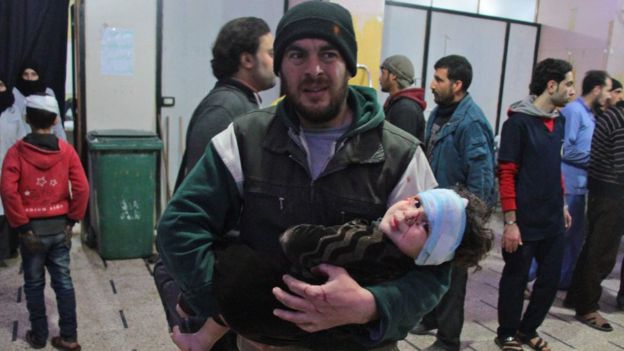
The head of safety and security for the Union of Medical Care and Relief Organizations (UOSSM), which operates medical facilities in the Eastern Ghouta, told the BBC that 45 people had been killed and another 250 injured on Wednesday alone.
Dr Ahmad Dbis said that since Sunday, ten members of medical staff and volunteers had been killed and 14 medical facilities were taken out of service, with five totally destroyed.
The UK-based Syrian Observatory for Human Rights put the total death toll since Sunday at 296.
It said that barrel bombs - containers filled with explosives and shrapnel - were used in government strikes on the towns of Jisreen and Kfar Batna on Wednesday.
It follows the bombardment on Tuesday of at least 10 towns and villages across the Eastern Ghouta.
Syrian state television reported that at least six people living in government-controlled areas of eastern Damascus were killed earlier this week - and 28 others wounded - by shells fired from the Eastern Ghouta.
The Syrian military said it carried out "precision strikes" on areas from which the shells were launched.
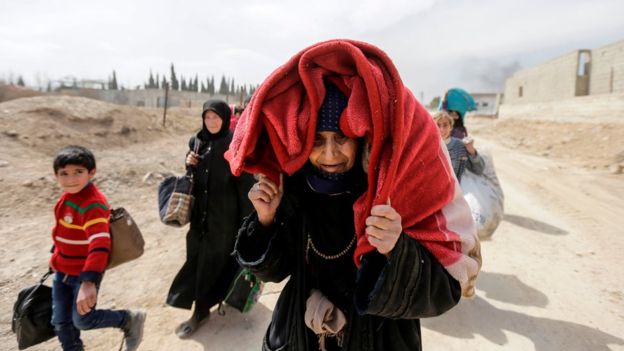
Since Sunday, activists say nearly 300 people have died, more than 60 of which were children. At least 1,400 people have been injured, they say.
What can the international community do about it?
By Jonathan Marcus, BBC diplomatic correspondent
The catastrophe in eastern Ghouta is unfolding as the war in Syria enters a new and even more dangerous phase. The international community is impotent to act, not least because key members of that community are deeply implicated in what is going on, not least Russia.
Other regional players like Turkey and Iran are acting to secure their own long-term strategic interests. So too is Washington though its goals seem uncertain now that IS is defeated and the Assad regime remains in power.
There is no consensus in the international community, no great leadership in evidence, and no shared sense of what Syria's future should be. Just as the international community has failed to halt the use of chemical weapons, so too it has been unable to secure humanitarian access to those at greatest risk.
Is humanitarian aid getting in?
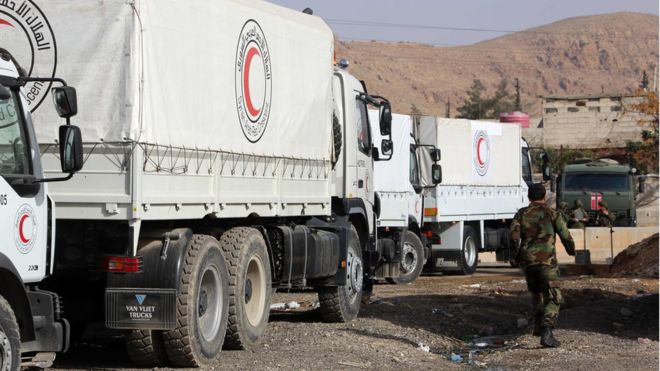
No. The government has allowed one humanitarian convoy into the Eastern Ghouta since late November, and there are severe shortages of food.
A bundle of bread now costs close to 22 times the national average and 12% of children under five years old are said to be acutely malnourished.
On Wednesday, the International Committee of the Red Cross (ICRC) joined the UN in calling for emergency humanitarian access to allow much needed aid to be delivered and the wounded to be evacuated.
"Wounded victims are dying only because they cannot be treated in time. In some areas of Ghouta, entire families have no safe place to go," the ICRC's Marianne Gasser said in a statement.
"On the other side of the frontline, people in Damascus are in constant fear that their children will be hit by falling mortars. This is madness and it has to stop. Civilians must not be targeted," she added.
The UN has already called for a ceasefire.
The violence in the region - designated as a "de-escalation zone" by Syria's main allies, Russia and Iran, as well as Turkey - is the worst since 2013, when a chemical attack killed hundreds of people, activists say.
What else is going on in Syria?
Meanwhile, pro-government fighters have been sent to the Kurdish enclave of Afrin in northern Syria to confront an offensive by Turkish troops and Syrian rebels.
Turkey fired shells near the advancing columns, which, it says, forced the pro-government fighters into retreat.
Afrin lies just south of the Turkish border. Turkey is trying to oust the Kurdish YPG militia, which controls the area and which has called on the Syrian military for help.
Syria has denounced the Turkish offensive as a "blatant attack" on its sovereignty, while Turkey has insisted it will not back down.
Syrian government forces are also carrying out offensives on the rebel-held north-western province of Idlib. The UN says more than 300,000 people have been displaced by the fighting there since December.