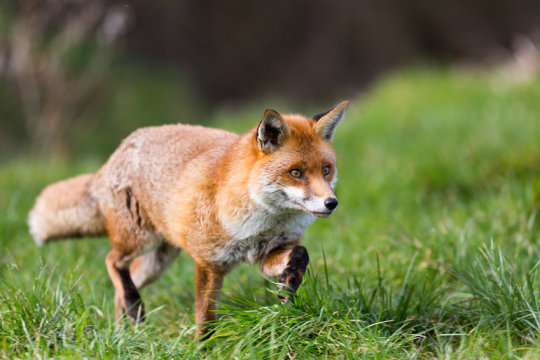
Sequenced fox genome hints at genetic basis of behavior
-
 Loading...
 - Genevieve Francoise
- 07 Aug 2021
- 1074 Views
- 0 Like
- 0 Comment
For nearly 60 years, the red fox has been teaching scientists about animal behavior. In a long-term experiment, foxes at the Russian Institute of Cytology and Genetics have been selected for tameness or aggression, recreating the process of domestication from wolves to modern dogs in real time. Today, with the first-ever publication of the fox genome, scientists will begin to understand the genetic basis of tame and aggressive behaviors, which could shed light on human behavior, as well.
"We've been waiting for this tool for a very, very long time," says Anna Kukekova, assistant professor in the Department of Animal Sciences at the University of Illinois and lead author of the paper. She has been studying the famous Russian foxes since 2002.
"In our previous work, we tried to identify regions of the fox genome responsible for tame and aggressive behavior, but these studies required a reference genome and all we could use was the dog genome. For us, the fox genome provides a much better resource for genetic analysis of behavior."
After sequencing and assembling the fox genome, the team turned to the famous Russian foxes to look for genetic regions differentiating the tame, aggressive, and conventional populations -- farm-raised foxes ancestral to the tame and aggressive populations but not bred for any particular behavioral trait.
The researchers sequenced the genomes of 10 individuals from each population, then compared them to the full fox genome and each other. The three populations differed in 103 genomic regions, some of which turn out to be responsible for the tame and aggressive behaviors.
"Finding genomic regions at such resolution was beyond any expectations with our previous tools. Now, for the first time, we could not only pinpoint part of a chromosome which makes foxes more tame or aggressive, but we could identify specific genes responsible for it," Kukekova says.
The team compared the 103 genomic regions to those of other sequenced mammals and found some compelling similarities. For example, they identified matches between behavior regions in foxes with regions important in domestication in dogs and with a region associated with Williams-Beuren syndrome in humans, a genetic disorder characterized by extremely outgoing, friendly behavior.
"Oddly enough, we found the Williams-Beuren region in aggressive foxes, not tame ones. We thought it would be the opposite," Kukekova says. The mysterious finding underscores how much more research is needed before the regions are fully understood.
But the researchers dove deeper. As a test run, they honed in on a single gene, known as SorCS1, which is involved in synapse formation, functioning, and plasticity, as well as additional functions. Although it had never before been known to contribute to social behavior, SorCS1 was clearly associated with a very specific behavior in foxes.
Human handlers at the Russian Institute of Cytology and Genetics interact with the foxes in a very controlled way as part of their videotaped fox behavioral assessments. Handlers stand near the enclosures for one minute, hold the door open for another minute, reach toward the fox for a third minute, then close the door, and stand near the enclosure for one final minute. The tamest foxes continue to clamor for human attention during the final minute of the assessment. It's this group of foxes that has a version of the SorCS1 gene not found in the aggressive population.
"We think this gene makes foxes more tame, but we don't want to overemphasize it -- tameness isn't associated with a single gene. The picture is definitely more complex," Kukekova says.
The article, "Red fox genome assembly identifies genomic regions associated with tame and aggressive behaviors," is published in Nature Ecology & Evolution. The full list of authors includes Anna Kukekova, Jennifer Johnson, Xueyan Xiang, Shaohong Feng, Shiping Liu, Halie Rando, Anastasiya Kharlamova, Yury Herbeck, Natalya Serdyukova, Zijun Xiong, Violetta Beklemischeva, Klaus-Peter Koepfli, Rimma Gulevich, Anastasiya Vladimirova, Jessica Hekman, Polina Perelman, Aleksander Graphodatsky, Stephen O'Brien, Xu Wang, Andrew Clark, Gregory Acland, Lyudmila Trut, and Guojie Zhang.
Funding was provided by National Institutes of Health grant GM120782, USDA Federal Hatch Project 538922, the Russian Science Foundation grants 16-14-10009 and 16-14-10216, the Institute of Cytology and Genetics of the Siberian Branch of the Russian Academy of Sciences grant 0324-2018-0016, grants from Campus Research Board and Office of International Programs of the University of Illinois at Urbana-Champaign. The project was also supported by the Strategic Priority Research Program of the Chinese Academy of Sciences (grant XDB13000000).


