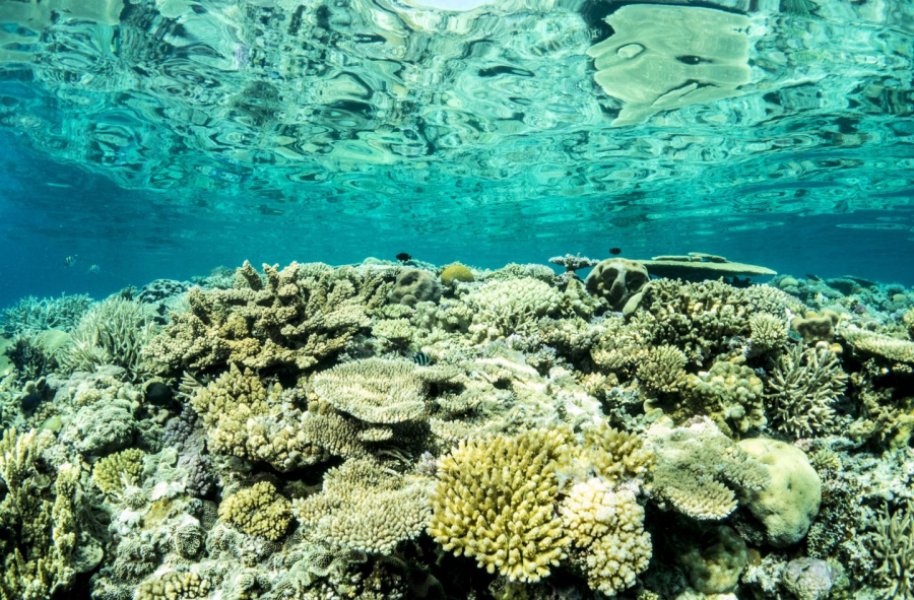
Resilience of Great Barrier Reef offers opportunities for regeneration
-
 Loading...
 - Courtney Trump
- 29 Nov 2020
- 1199 Views
- 0 Like
- 0 Comment
New research has found that, despite the extensive damage to coral in recent events, there are still 100 reefs on the Great Barrier Reef that are well suited to promoting the regional recovery of the ecosystem after major disturbances. The results publishing 28 November in the open access journal PLOS Biologyby Dr Karlo Hock, Prof Peter Mumby, and colleagues from the University of Queensland, CSIRO, the Australian Institute of Marine Science, and the University of Sheffield, suggest that these reefs not only appear to be less at risk of being exposed to damaging effects of bleaching and starfish predation, but are also well connected to other downstream reefs by ocean currents, and therefore possess the potential to provide coral larvae to support the recovery of other reefs.
Australia's iconic Great Barrier Reef, a large coral ecosystem consisting of more than 3800 individual reefs, has recently been subjected to various disturbances, including unprecedented instances of coral bleaching events over the last two years, as well as ongoing and widespread outbreaks of the coral-eating crown-of-thorns starfish. This has yet again brought to public attention the current state of coral reefs worldwide and the challenges that need to be met to preserve them.
The new study identified 100 reefs that fulfil three highly desirable criteria to promote coral recovery. First, the reefs should lie in cool areas and rarely experience damage from coral bleaching themselves; this means that corals are relatively healthy on these reefs and able to supply larvae (fertilised eggs) to other reefs. Second, because larvae travel on ocean currents, reefs should be located in areas that supply larvae to as many reefs as possible. Third, while these reefs should supply coral larvae, they should not spread the larvae of the crown-of-thorns starfish.
"Finding these 100 reefs is a little like revealing the cardiovascular system of the Great Barrier Reef," states author Professor Peter Mumby. "Although the 100 reefs only make up 3% of the entire GBR, they have the potential to supply larvae to almost half (45%) of the entire ecosystem in a single year."
"The presence of these well-connected reefs on the Great Barrier Reef means that the whole system of coral reefs possesses a level of resilience that may help it bounce back from disturbances," says the paper's lead author Dr Karlo Hock, "as the recovery of the damaged locations is supported by the influx of coral larvae from the non-exposed reefs."
"Unfortunately, these findings by no means suggest that the Great Barrier Reef corals are safe and in great condition, and that there are no reasons for concern," Dr Hock cautions, "Indeed, the fact that the study only identified around a hundred of these reefs across the entire 2300km length of the massive Great Barrier Reef emphasises the need for both effective local protection of critical locations and reduction of carbon emissions in order to support this majestic ecosystem.
The research also indicates that focusing the efforts on these well-connected reefs and monitoring their health may be a step in the right direction, but the ecosystem remains vulnerable to the impacts of multiple stressors. "While more research is needed to determine to what extent the Great Barrier Reef will benefit from replenishment by these 100 reefs, given the scale of the recent disturbances, the importance of supporting such natural recovery mechanisms is likely to increase in future as climate change makes various disturbances more intense and unpredictable," Prof Mumby adds. "Saving the Great Barrier Reef is possible but requires serious mitigation of climate change and continued investments in local protection. We talk to management agencies frequently and our results can inform where they target on-the-ground actions."


