Private education booms in Poland amid impact of politics and pandemic on public schools
-
 Loading...
 - Daisy Murray
- 11 Jul 2022
- 125 Views
- 0 Like
- 0 Comment
This school year, around 36,700 pupils in Warsaw are attending private schools, according to estimates from city hall. That is over 20% more than the figure of 30,000 in 2018 and an increase of 37% since 2016, when it stood at 26,754. It also means that 12% of all school pupils in the city are now being privately educated.
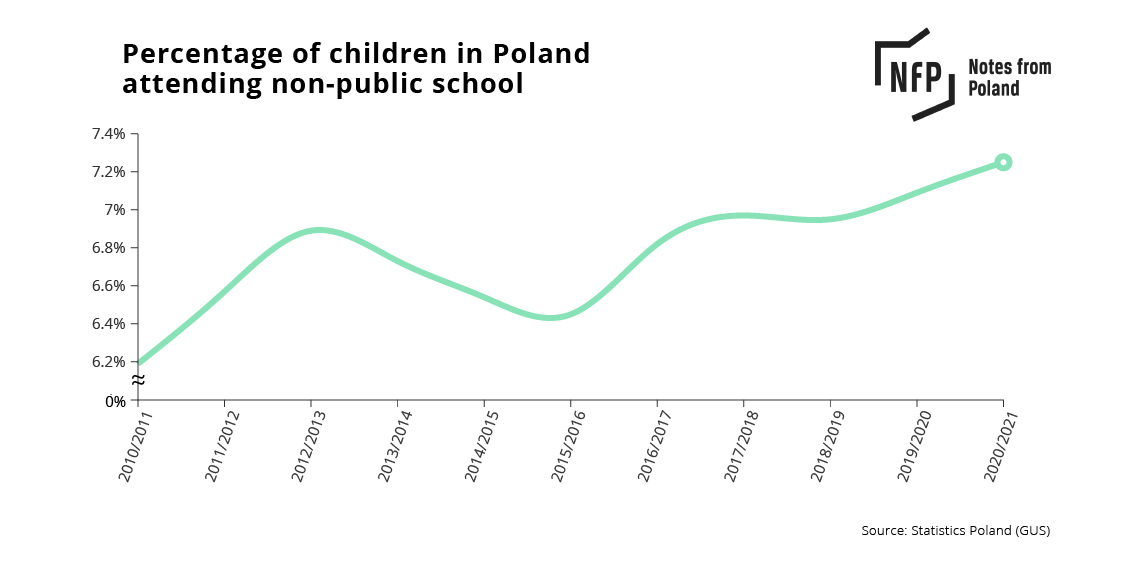
Nationwide, the figure has also been rising, though it remains well below the level in the capital. Data from Statistics Poland (GUS). a state agency, show that the proportion of children in Poland attending non-public schools reached 7.25% in the 2020/21 academic year, up from 6.45% in 2015/16.
One of the reasons behind the trend has been a shortage of teachers and overcrowded classes in public schools. In Warsaw, the number of teacher vacancies has risen from 1,600 three years ago to more than 2,000 at the beginning of this school year. Approximately 7% of teachers quit their jobs in the 2020/2021 school year.
Iga Kazimierczyk from the Space for Education foundation says that a closer look at most private schools reveals that they do not offer anything extraordinary. What is dramatic about the current situation, she argues, is that people in Poland need to pay for things that are standard in western Europe.
“Parents declare that they choose private education simply because they want a school that has no vacancies, that offers extra classes, or simply has a common room,” Kazimierczyk told Notes from Poland.
Many teachers left public schools due to the strains caused by the pandemic, which forced them to quickly adapt to online classes and to lose direct contact with students for long periods.
“Private schools adapted to the pandemic situation more quickly”, as both teachers and students had access to better equipment and the switch to online education was smoother, says Dorota Åoboda, head of the education commission on Warsaw city council and also a politician from the opposition Civic Platform (PO) party.
Arkadiusz Walczak, director of the Warsaw Centre for Socio-Educational Innovation and Training, believes that psychological problems and other challenges that many students are facing in the aftermath of lockdowns and social distancing will probably further fuel the trend of shifting to private education.
“After a period of online education, a lot of students have problems with adapting again to overcrowded [public] schools, which often can’t offer an individual approach and support,” he told Notes from Poland. Read More…