Ocean waves following sea ice loss trigger Antarctic ice shelf collapse
-
 Loading...
 - Agnes Lehnert
- 17 Jun 2021
- 1304 Views
- 0 Like
- 0 Comment
Storm-driven ocean swells have triggered the catastrophic disintegration of Antarctic ice shelves in recent decades, according to new research published in Nature today.
Lead author Dr Rob Massom, of the Australian Antarctic Division and the Antarctic Climate and Ecosystems Cooperative Research Centre, said that reduced sea ice coverage since the late 1980s led to increased exposure of ice shelves on the Antarctic Peninsula to ocean swells, causing them to flex and break.
"Sea ice acts as a protective buffer to ice shelves, by dampening destructive ocean swells before they reach the ice shelf edge," Dr Massom said.
"But where there is loss of sea ice, storm-generated ocean swells can easily reach the exposed ice shelf, causing the first few kilometres of its outer margin to flex."
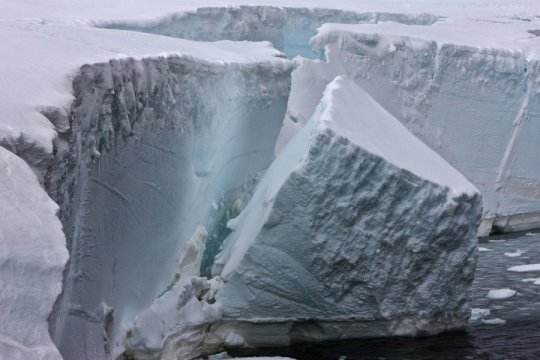
"Over time, this flexing enlarges pre-existing fractures until long thin 'sliver' icebergs break away or 'calve' from the shelf front."
"This is like the 'straw that broke the camel's back', triggering the runaway collapse of large areas of ice shelves weakened by pre-existing fracturing and decades of surface flooding."
Study co-author Dr Luke Bennetts, from the University of Adelaide's School of Mathematical Sciences, said the finding highlights the need for sea ice and ocean waves to be included in ice sheet modelling.
This will allow scientists to more accurately forecast the fate of the remaining ice shelves and better predict the contribution of Antarctica's ice sheet to sea level rise, as climate changes.
"The contribution of the Antarctic Ice Sheet is currently the greatest source of uncertainty in projections of global mean sea level rise," Dr Bennetts said.
"Ice shelves fringe about three quarters of the Antarctic coast and they play a crucially important role in moderating sea level rise by buttressing and slowing the movement of glacial ice from the interior of the continent to the ocean."
"While ice shelf disintegration doesn't directly raise sea level because they are already floating, the resulting acceleration of the tributary glaciers behind the ice shelf, into the Southern Ocean, does."
Study co-author, Dr Phil Reid, from the Australian Bureau of Meteorology, said the research identifies a previously under-appreciated link between sea ice loss and ice shelf stability.
"Our study underlines the importance of understanding the mechanisms driving these sea ice trends, particularly in regions where sea ice acts as a protective buffer against ocean processes," he said.
The discovery comes after the international research team, from Australia, the United States and New Zealand, combined satellite images and surface and ocean wave data with modelling, to analyse five major ice shelf disintegrations, between 1995 and 2009.
These included the abrupt and rapid losses of 1600 square kilometres of ice from the Larsen A Ice Shelf in 1995, 3320 square kilometres from the Larsen B Ice Shelf in 2002, and 1450 square kilometres from the Wilkins Ice Shelf in 2009.
Each disintegration event occurred during periods when sea ice was significantly reduced or absent, and when ocean waves were large.
In only a matter of days, the collapse of the Larsen B Ice Shelf in 2002 removed an area of ice shelf that had been in place for the previous 11,500 years. Removal of the ice shelf buttressing effect also caused a 3- to 8-fold increase in the discharge of glacial ice, behind the shelf, into the ocean, in the year following disintegration.
DEFINITIONS OF TERMS USED
An ice sheet forms through the accumulation of snowfall, in this case on the Antarctic continent, when annual snowfall exceeds annual snowmelt. Over thousands of years the layers of snow build up and compact, forming a sheet of ice up to thousands of metres thick and thousands of kilometres across. As the ice thickens, the increasing height of snow and ice causes the ice sheet to flow.
The Antarctic Ice Sheet covers an area of about 14 million square kilometres; by comparison, the area of Australia is about 7.7 million square kilometres, and that of the USA is about 9.8 million square kilometres. It contains more than 90% of the world's ice -- enough to potentially raise global mean sea level by about 57 metres.
Grounded ice is that part of the ice sheet that is land-based and not floating on the ocean. Melting of grounded ice above sea level contributes to sea level rise.
Ice shelves are thick plates of ice, up to several hundred metres thick and fed by tributary glaciers. They are floating seaward extensions of the grounded ice sheet.
Sea ice is ice that originates from the freezing of seawater (unlike ice sheets, glaciers, icebergs and ice shelves). Sea ice typically forms a thin and highly-dynamic veneer up to a few metres thick that covers between about 3 million square kilometres (in winter) to 19-20 million square kilometres (in summer) of the Southern Ocean surrounding Antarctica. By comparison, the areas of the Antarctic continent, Australia and the USA are about 14, 7.7 and 9.8 million square kilometres, respectively.
Ocean swell is defined as regular long-period waves that are generated by distant storms and are no longer growing or being sustained by the wind (as opposed to locally-generated wind waves).
The Antarctic Peninsula forms a mountainous 1300 km northward extension of Antarctica towards the southern tip of South America. It forms the northernmost part of mainland Antarctica.