New AI Can Automatically Detect a Serious Heart Condition
-
 Loading...
 - Helle Jorgensen
- 01 Aug 2022
- 105 Views
- 0 Like
- 0 Comment
Utilizing intravascular optical coherence tomography images, a new technique made it easier to identify plaque erosion
Researchers have created a brand-new artificial intelligence (AI) technique that uses optical coherence tomography (OCT) images to automatically detect plaque erosion in the arteries of the heart. Monitoring arterial plaque is crucial because, if it disintegrates, it may obstruct blood flow to the heart, triggering a heart attack or other dangerous problems.
“If cholesterol plaque lining arteries starts to erode it can lead to a sudden reduction in blood flow to the heart known as acute coronary syndrome, which requires urgent treatment,” said research team leader Wang from the University of Electronic Science and Technology. “Our new method could help improve the clinical diagnosis of plaque erosion and be used to develop new treatments for patients with heart disease.”
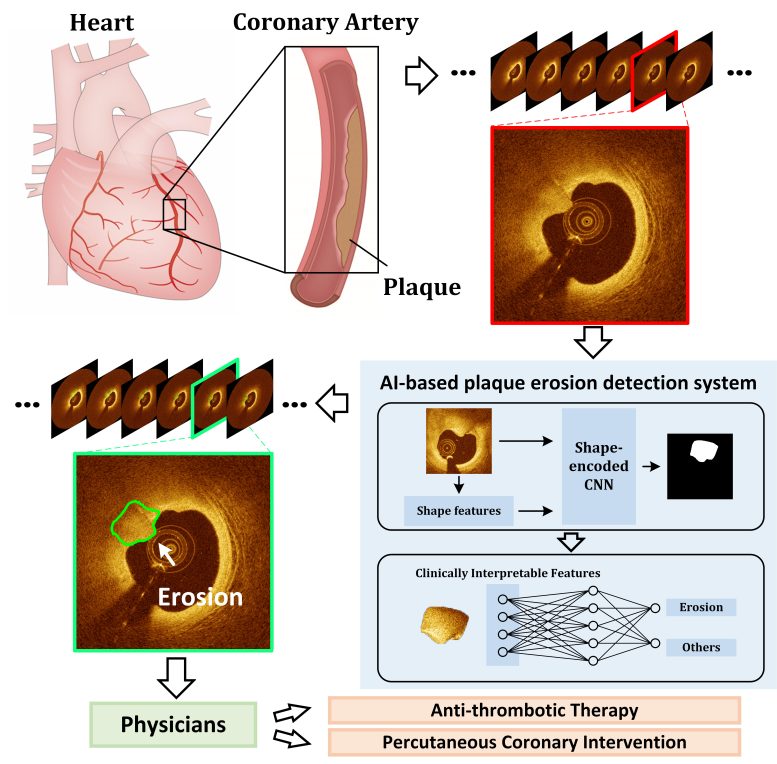
OCT is an optical imaging technique with micron-scale resolution that may be utilized within blood vessels to produce 3D pictures of the coronary arteries, which carry blood to the heart. Although intravascular OCT is being used by doctors more frequently to check for plaque erosion, there is a substantial level of interobserver variability because of the volume of data generated and the difficulty of visually interpreting the images.
In order to address this issue, Wang collaborated with a team of engineers from his institution and medical professionals from The 2nd Affiliated Hospital of Medical University under the direction of Bo to create an automated, objective method that uses AI to identify plaque erosion based on OCT images. They explain the new method in the Optica Publishing Group journal Biomedical Optics Express and demonstrate that it is accurate enough to possibly serve as the foundation for clinical diagnosis.
“Our new AI-based method can automatically detect the presence of plaque erosion using the original OCT images without any additional input,” said Wang. “The ability to detect plaque erosion objectively and automatically will reduce the laborious manual assessment associated with diagnosis.”
Applying AI
The new method consists of two primary steps. First, an AI model known as a neural network uses the original image and two pieces of shape information to predict regions of possible plaque erosion. The initial prediction is then refined with a post-processing algorithm based on clinically interpretable features that mimic the knowledge professional physicians use to make a diagnosis.
“We had to develop a new AI model that incorporates explicit shape information, the key feature used to identify plaque erosion in OCT images,” said Wang. “The underlying intravascular OCT imaging technology is also crucial because it is currently the highest resolution imaging modality that can be used to diagnose plaque erosion in living patients.”
When OCT is used for intravascular imaging, the imaging probe is automatically pulled backward inside a catheter, producing hundreds of images for each pullback. The researchers tested their method using 16 pullbacks of 5,553 clinical OCT images with plaque erosion and 10 pullbacks of 3,224 images without plaque erosion. The automated method correctly predicted 80 percent of the plaque erosion cases with a positive predictive value of 73 percent. They also found that diagnoses based on the automated method matched well with those from three experienced physicians.
“Although further safety validation and regulatory approval are needed for stand-alone clinical use in patients, the technique could be used to facilitate diagnosis of plaque erosion,” said Wang. “This would involve physicians making a final check of the algorithm’s finding and then determining the cause of acute coronary syndrome and the best treatment strategies.”
Studying new treatments
The method could also be useful for analyzing the massive amounts of existing OCT data by eliminating the time-consuming and tedious process of manual image analysis. This could help scientists improve the identification and treatment of plaque erosion. For example, a stent is often used to recover reduced blood flow in patients with acute coronary syndrome, but recent studies suggest that some medications might offer a less-invasive alternative.
“Intravascular imaging, accompanied with AI technologies, can be an extremely valuable tool for diagnosis of coronary artery disease and treatment planning,” said Wang. “In the future, this new approach could help physicians develop individualized treatment strategies for optimal management of patients with acute coronary syndrome.” Read More...