Museum researchers rediscover animal not seen in 30 years
-
 Loading...
 - Ken Ma
- 20 Apr 2021
- 1313 Views
- 0 Like
- 0 Comment
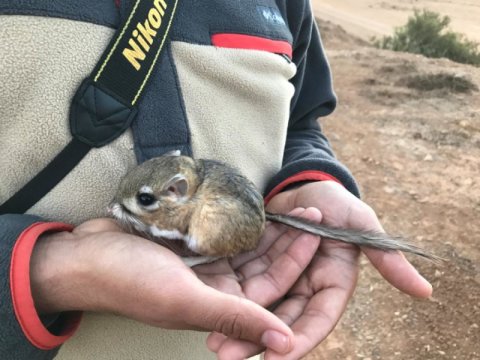
Researchers from the San Diego Natural History Museum (The Nat) and the non-profit organization Terra Peninsular A.C. have rediscovered the San Quintin kangaroo rat (Dipodomys gravipes) in Baja California; the Museum is partnering with the organization and local authorities on a conservation plan for the species.
The San Quintin kangaroo rat was last seen in 1986, and was listed as endangered by the Mexican government in 1994. It was held as an example of modern extinction due to agricultural conversion. In the past few decades, San Quintin, which lies 118 miles south of Ensenada, has become a major agricultural hub, converting huge areas of native habitat into fields and hot houses for tomatoes and strawberries.
Despite active searches and monitoring over the years, there had been no sign of the animal until this past summer, when Museum Mammalogist Scott Tremor and Research Associate Sula Vanderplank were in the field conducting routine monitoring of small mammal communities. Having read the field notes of the person who had seen it decades ago, they were aware of its former occurrence in the area, but were amazed to find four individuals by using traditional field techniques and live traps.
This animal is about 5 inches in length with a tufted tail. It is an herbivore that lives in arid lowlands and gets its name from its large, powerful hind feet that propel the animal in large bounds (like a kangaroo). It is larger than other kangaroo rats in the region, and is feistier than its relatives.
"Not only is this discovery a perfect example of the importance of good old-fashioned natural history field work, but we have the opportunity to develop a conservation plan based on our findings," said Tremor. "The ability to take our research and turn it into tangible conservation efforts is thrilling. It is a commitment to preserving the uniqueness of the Baja California Peninsula."
The discovery will be highlighted in an article by Tremor, Vanderplank, and Dr. Eric Mellink of the Center for Scientific Research and Higher Education of Ensenada, Baja California (CICESE) in the scientific journal Bulletin of the Southern California Academy of Sciences.
Since the initial discovery, the San Quinton kangaroo rat has been found to also persist inside the Valle Tranquilo Nature Reserve just south of San Quintín, which is owned and managed by the local non-profit organization Terra Peninsular A.C. This reserve is recognized as an area voluntarily destined for conservation by the National Commission of Natural Protected Areas (CONANP) and will protect the future of the species into perpetuity.
The Nat will work with Terra Peninsular and Dr. Exequiel Ezcurra, director of the University of California Institute for Mexico and the United States (UC MEXUS), on a conservation plan for the small mammal communities of the area, with an emphasis on the San Quintin kangaroo rat.
"Terra Peninsular has been monitoring the nature reserves looking for this species. You can't imagine how happy we are to find out that after all these efforts and with the help of The Nat we can be part of this rediscovery and continue working on its protection," said Jorge Andrade, adaptive manager coordinator at Terra Peninsular, who has also been involved in the project. "It's very gratifying for us to think that the San Quintin kangaroo rat persists in the area to some extent, thanks to the efforts of the staff, board members, and associated researchers of our organization."
This plan, which is made possible with critical support from The JiJi Foundation Fund at the International Community Foundation, will be developed cooperatively with a working group created by Terra Peninsular and composed of local authorities, academic institutions and staff members. It will be written in both English and Spanish, will include restoration strategies, habitat improvements, molecular analysis of population health, land protection strategies and outreach and educational materials, and will identify key concerns for the future of the species.
The Museum's research department, the Biodiversity Research Center of the Californias, conducts field explorations and engages in collections-based research to document and conserve our region's natural history and biodiversity. This is the third mammal that was thought to be extinct that museum staff have rediscovered in the Baja California Peninsula in the recent past: others include the high elevation California vole (Microtus californicus huperuthrus) and the round-tail ground squirrel (Xerospermophilus tereticaudus apricus).
"These rediscoveries speak to hope and resilience in a changing world," said Vanderplank, who is also a science advisor at Terra Peninsular. "We are learning so much about this animal and its ecology, and we're delighted to know that it is permanently protected in the Valle Tranquilo Nature Reserve."