Keeping Hungary's folk traditions alive
-
 Loading...
 - Layla Fouad
- 16 Jun 2022
- 239 Views
- 0 Like
- 0 Comment
It's a glorious spring day in Budapest and I've come to take a peek inside Hungarian Heritage House.
If you've never been, this beautiful capital city is bisected by the blue Danube, with castle, museums and residential area in Buda, and the bustling, partying, political heart in Pest.
Tourists are drawn to its famous thermal spas, elegant architecture and good value bars and restaurants - and yes some are hard-partying stags and hens.

But here in Buda, at one end of a quiet square is a grand Empire-era building that's a bastion of the country's folk arts. Its purpose is similar to the Primrose Hill headquarters of the English Folk Dance and Song Society - to preserve and promote a folk tradition
Not only is the structure more imposing than Cecil Sharp House, but it appears Hungary's centuries-old rural songs and dances are more embedded in cultural life than our much derided Morris Men. Here, it's a living tradition, with children taught about their folk inheritance in school.
I saw it for myself later that night. The venue's regular Dance House session had drawn a large, enthusiastic crowd for the equivalent of a ceilidh - complete with caller, folk band, sweaty dancing and nice cold beer. The women were all twirling skirts and stomping feet, the men have the showier, peacock moves of rhythmic body slaps and kicks. Just like a good ceilidh, there's an uplifting collective joy and pride in a shared tradition that really doesn't feel like a relic of the past.
The performers in the Hungarian State Folk Ensemble of Budapest are the experts in this music, and dances such as the Shepherd's or Jumping dance. They all take a degree in the folklore of the Carpathian Basin which embraces Hungarian, Romanian, Gypsy and Slavic traditions.
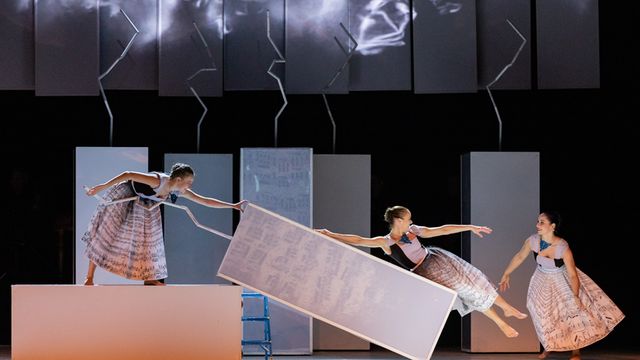
London audiences have a chance to see them at Sadler's Wells on June 3 in Liszt Mosaics, a celebratory dance concert focusing on the life and work of Hungarian hero Franz Liszt - with musical nods to his peers Chopin and Paganini.
Director Gabor Mihalyi says the show reflects three elements: "Liszt as Hungarian, Liszt as priest and Liszt as virtuoso."
It's a glorious mix of traditional and modern dance, with music ranging from Liszt's Hungarian Rhapsodies to religious songs such as Laudate Dominum. The Islington venue will resound to fiendishly quick bowing by violinists Alexandra da Costa and Istvan Pal Szalonna, soaring folk songs from Esther Pal, and Gregorian Chanting from extraordinary vocalists in the Orthodox tradition - all backed by the Royal Philharmonic Concert Orchestra.

"It represents his relationship to women. He loved women, and women loved him back," says Mihalyi, adding that it was only in later life that Liszt took the celibacy vows of a priest.
"Even though he is the most famous Hungarian composer it is mostly his piano and orchestral pieces that are played all over the world. We felt a certain lack and wanted to do something based on his music in Hungary. Liszt wasn't a folk musician, he lived in coffee houses and performed in concert halls, but what connects his music to traditional folk dance is the rhythm in the music culture of that Romantic period."
Sitting at the crossroads of Europe, bounded today by Austria, Ukraine, Romania, Serbia and Slovakia, Hungary has been a hostage to fortune over the centuries, invaded or occupied by the Ottomans, Hapsburgs, Nazis and Soviets before emerging as a modern European country.
After the collapse of the Austro-Hungarian Empire, Hungary lost 71 percent of its territory and 58 percent of it population when borders were reassigned by the Trianon Treaty - including parts of Slovakia and Transylvania where its folk tradition was strong.
Under the Soviets there was apparently a Communist song committee to scour popular music for traces of subversion, and many Hungarian creatives fled after the failed revolution in 1956 - a fair few settling in northwest London to write in exile or open businesses such as Louis' famous Hampstead patisserie.
It cannot have been easy to keep the flame of folk traditions alive, let alone to become a big part of Hungary's national identity. Read More...