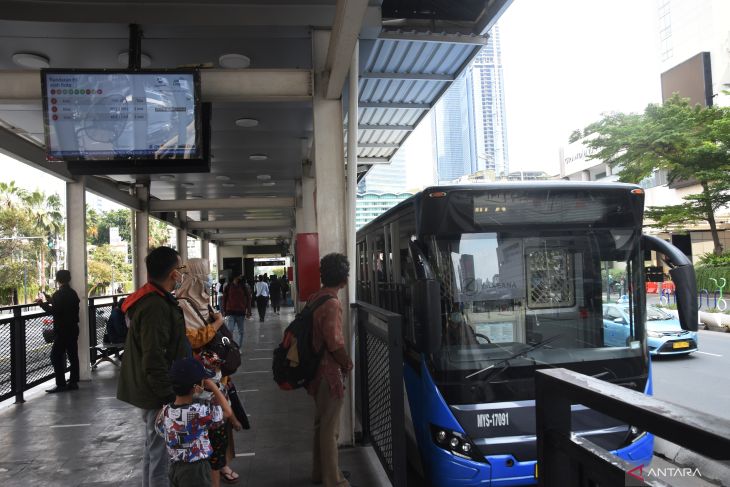
Jakarta amid Indonesia's public transportation problems.
-
 Loading...
 - Chang Chen
- 21 Apr 2022
- 337 Views
- 0 Like
- 0 Comment
With the approaching Eid al-Fitr festivities, here in Indonesia, the transportation system always becomes a topic of discussion among many. Currently, our vast population needs better and more efficient public transportation, not only between cities but, more importantly, around cities themselves because all year long, we commute more inside our hamlets and towns.
Several problems have been faced by people in big cities across the country.
Fierce competition appears to exist among government-operated public transport, private online transportation, and privately-operated city transportation.
The competition felt quite threatening for the city's micro transportation or angkotan kota (“angkot”). Apart from the availability of online transportation, such as Grab and GoJek, several angkot drivers saw their incomes dwindle due to the COVID-19 pandemic in 2020.
An extensive investigative report by Kompas daily on March 17-18, 2022, showed how low their earnings were as compared to previous years.
As elaborated in media, angkot drivers in Bandung, Semarang, Surabaya, and Yogyakarta complained about the depleting income.
For instance, an angkot driver in Semarang claimed that after online transportation came into existence, their revenues dropped drastically.
In Surabaya, the number of angkot routes dropped, from 58 in 2016 to 11 in 2022. Director of the Institute for Transportation and Development Policy (ITDP) for Southeast Asia, Faela Sufa, called on the government to pay special attention to this case.
“Every transportation development should include the management and drivers of angkot, as other than the need of sustaining their business that carries the livelihood of many people, these angkots have also served the public for decades, right? That is why it is essential for the government to include them in the improvement projects,” Faela Sufa stated in a Kompas news video on March 18, 2022.
If the government does not immediately intervene to help organize or integrate angkot into government-owned transportations, it may possibly happen that in the next few years, angkot will become part of history.
In fact, what Sufa expected has already taken place in Jakarta. Its government has integrated its local transportation in the best way. As cited by media, even before the pandemic, Jakarta's ranking in the TomTom Traffic Index was gradually improving, as the number of public transportation passengers increased.
Apart from its plan to bring in 100 new electric buses under the TransJakarta fleets to promote Jakarta as a emission-free city, Jakarta is expecting to invite more citizens to shift to public transportation while improving its air quality.
Planned in phases, this project is expected to complete half of the target by 2025.
Through the success, an innovation of transforming the entire TransJakarta fleet to electric-based vehicles, also as part of creating a green city, is currently the focus.
Efforts to make Jakarta a cleaner city was apparent from the various actions that include an important breakthrough by improving the city’s public transportation system through the JakLingko program.
JakLingko was designed to integrate payment and mobility between Jakarta’s transport modes that includes TransJakarta, KRL Commuterline, MRT, LRT, and local angkot (Mikrotrans) just by a single card.
​​​​​​​Given that the crowded capital city has a population of more than 11 million, the Jakarta government has applied a comprehensive transportation strategy for smooth mobility in the capital city.
If earlier Jakarta had a low unified system with different operators managing solitarily, today, Jakarta's public transportation has three aspects of integration: accessible routes, affordable tickets, and a unified management through the JakLingko program.
​​​​​​​The idea of integrated transport system began in 2018, when Jakarta’s around 25 public transportation operators complained about the unfair centralized costs regulation imposed that affected their budget.
However, immediately after meetings with those operators, Jakarta Governor Anies Baswedan created an integrated system that soon became good news for the operators.
​​​​​​​Through this, the Jakarta government pays for the service provided by the operators. Drivers are paid through the kilometers covered in different routes.
Thus, the operators can run their business sustainably and the government can continuously pay for their services through a reasonable and measurable price, so that Jakarta's citizens can ride conveniently across Jakarta's area.
With 248 routes and 4,123 fleets, currently, JakLingko covers 83 percent of the city, up from 20 percent in 2018, and is expected to cover 95 percent soon.
It also changed the concept of micro transportation or “angkot” wherein drivers do not need to chase deposits and wait on the roadside, thereby reducing the city traffic significantly.
​​​​​​​Through this, passengers can take a reliable and punctual means of transportation without unnecessary stops (“ngetem”). Contrary to those of other cities' “angkot” drivers, the JakLingko drivers have fixed monthly salary and working hours, without having to worry about the daily passengers’ count. Vehicle owners also have a definite income based on the kilometers clocked.
It also led to a positive ambience, as drivers were thanked for the ride due to the feeling that passengers are getting a “free ride” by using the one-time JakLingko card.
Until 2020, this program had reached up to one million passengers per day, from initially 350 thousand of daily ridership.
This also contributed to further coverage expansion that could improve the service altogether.
​​​​​​​Through the collaboration, mutual benefits are attained: operators became more prosperous, the government is served, and the community gets a reliable and fast transport service.
According to Baswedan, what is important for passengers is that they can go from one place to the other and can transit anywhere, only by the one-time pay.
In spite of the government's subsidy cost addition, the benefits of better routes, affordable prices, and convenience can be attained.
Some people tend to spend up to 30 percent of their income for transportation, but through this integrated system, those costs will fall to below 10 percent, so citizens can utilize the funds for other purposes.
Through further innovation, not only can it provide an economical solution but also ensure a better integrated city with greener facilities in the near future.
​​​​​​​Compare this with other big cities outside Jakarta, where public transportation costs are quite burdensome.
On March 17, Kompas reported that access to public transportation in Surabaya, Bandung, Semarang, and Yogyakarta also determines the welfare of its citizens.
The cost of living for residents in areas without public transport coverage will be higher.
Kompas’ research data shows that the components of public transportation costs in those cities can be as high as 40 percent of the citizens’ income.
However, those monthly costs could be minimized if the citizens choose public transportation, for instance, with a little extra walking to reach those modes.
However, this needs efforts from the government to solve the case, promising a better transportation mode for citizens while acknowledging the welfare of the drivers and those who are dependent on it, akin to what has been done by the Jakarta government.
Along the four years of its governorship, Jakarta has created a priority list on managing the issue of transportation system and its facilities.
After prioritizing pedestrian amenities, bicycle facilities, and emission-free vehicles, the Jakarta government has efficiently integrated public transportation system to be an enjoyable experience for its citizens. Read More...