Ideas and Tips for Photographing at a Fairground
-
 Loading...
 - Owen Graham
- 08 Jun 2022
- 262 Views
- 0 Like
- 0 Comment
Photographing at a fairground can be fun to do. It’s a fun place to go to, with lots of people, bright lights, and action. It can also provide some challenges for capturing great photos. I have some ideas and tips if you plan on photographing at a fairground.
The fairgrounds start appearing in the Netherlands again around springtime. These travel from place to place, providing a lot of thrilling amusement for lots of people. For the photographer, it can be a challenging subject. Shooting at a fairground at nighttime offers a lot of possibilities. The lights, action, and people having a great time are excellent subjects to take pictures of.
A fairground may seem like chaos at first. How is possible to shoot nice photos in that chaos, where people are walking back and forth, talking, calling, or screaming against a backdrop of ever-changing lights and movements? Do you want to take pictures of the fairground visitors or the attractions? What settings do you need, and how can you bring order to that chaos?

Camera Settings
It’s impossible to use one setting that works for every kind of photography at a fairground. The correct setting depends on the result you want to achieve or the subject you are capturing. Photographers often ask about the EXIF data when seeing a photo that is shot at a fairground. But that won’t offer a lot of help when they make their own attempt.
There are basically two kinds of photos you can take. The one is capturing the moments of people at the fairground. The other is the movements by the fairground attractions. Both require different settings.

The first one is perhaps the most difficult one. Shooting people often requires a reasonably fast shutter speed. It means you have to rely on high ISO levels, even if you’re able to use a wide aperture like f/1.8 or f/1.4. I definitely would recommend a narrow depth of field in order to isolate someone from their surroundings. It offers a way of reducing distractions in the background. Often, f/2.8 will do nicely.

Exposure can be tricky due to the big difference in light levels. The background is often much brighter compared to your subject. You either have to choose between exposure for the highlights and the subject in shadow or a well-exposed subject and blown-out highlights in the back. The choice is yours. It’s possible to use fill flash, but that will draw attention.
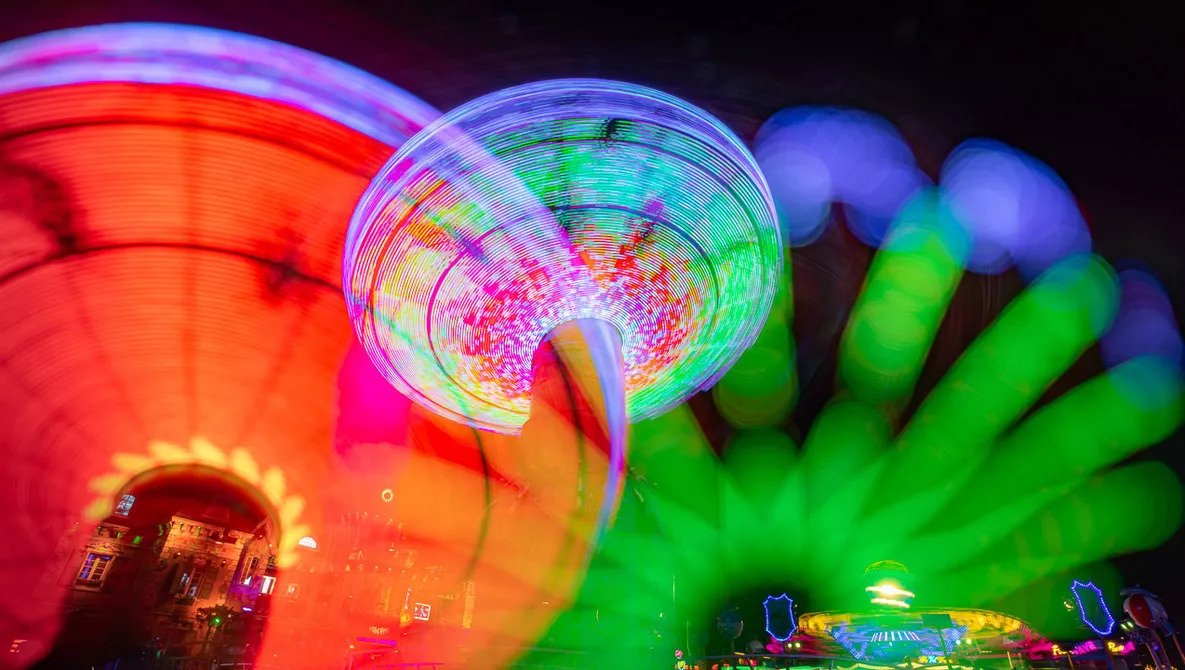
Capturing movement can be much easier. Just use a narrow aperture and a low ISO level. The shutter speed will become long enough to capture the movement of the lights. You could even use a neutral density filter to achieve the desired shutter speed more easily, but I wouldn’t recommend something that is beyond three stops. Of course, a tripod is advisable.


A Sense of Calmness in the Photo
A fairground can be quite chaotic. The chaos can be distracting if you try to capture too much in the frame. The use of a wide angle lens may allow you to get a lot of the lights and attractions in one shot, but it may not result in an attractive image.
It’s often better to choose a subject and concentrate on that. For instance, zoom in on people and capture the things they’re doing. Or you can capture great silhouettes of people who are standing in front of a brightly lit fairground attraction. Combine this with a longer shutter speed, and the results may surprise you.
Capturing Movement
Wherever you look at a fairground, it all seems to move. The attractions and their lights never stand still. Capturing these attractions with a fast shutter speed doesn’t show the dynamics of the fairground; it just freezes the moment. Extend your shutter speed to capture that movement. Sometime,s one second is enough, but you may want to experiment with that. Read More...