‘I was told they didn't offer C-sections' – the dangerous obsession with ‘natural births'
-
 Loading...
 - Ava Campbell
- 14 Apr 2022
- 341 Views
- 0 Like
- 0 Comment
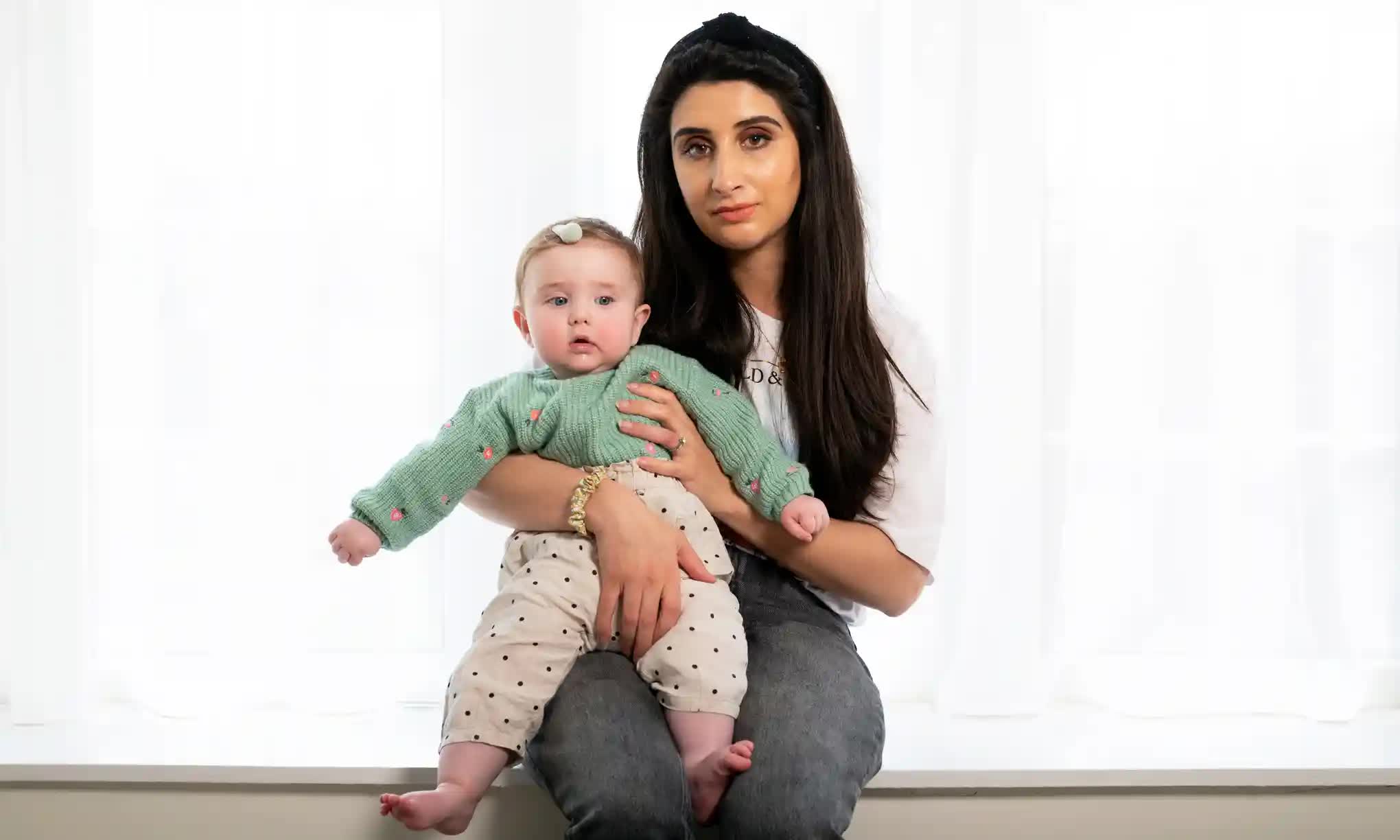
Sofia Shafaq, a 33-year-old accountant from Leeds, says she had been in labour for three days in July 2021, when she called her midwife and begged for a caesarean section. She had already been to the hospital three times, and, each time she had been sent home. She says the labour hadn’t progressed and she was only 2cm dilated. “It felt like I was going to die. Like someone had put a knife in me and was twisting it.” The midwife made her feel silly for asking for a casearean section. “She said: ‘That’s not something we offer.’”
Shafaq says that, when she was finally allowed into the labour ward, she hadn’t slept or eaten and was too exhausted to push the baby out. Staff had to use forceps and she tore, and had to have an episiotomy. Now, she has a prolapse, which she believes is due to the forceps. “I am angry,” she says. “There’s a lot of trauma there. I’m always in tears.” She believes that all of this would have been avoidable if staff at the hospital had listened. “I am suffering today, because I did not get what I wanted,” she says.
Last week, senior midwife Donna Ockenden issued her long-awaited review on the Shrewsbury maternity scandal. She found that nine mothers and 201 babies might have survived had staff provided better care. Mothers were denied caesarean sections and forced to suffer traumatic births because of an obsession with hitting “normal” birth targets, meaning that the trust had one of the lowest C-section rates in the country. In some instances, families were blamed when their babies died.
Shrewsbury follows other, much publicised maternity scandals: Morecambe Bay, where one mother and 11 babies died, east Kent, where the hospital trust recently pleaded guilty to criminal charges, and Nottingham, where 46 babies were left with brain damage. Across these cases, common themes recur: mothers not being listened to when expressing concerns about how their labour was progressing; staff fixated with vaginal birth at all costs, even when C-sections were medically necessary; and understaffed hospital units failing to monitor women appropriately.
After the review, women are speaking out about their experiences of giving birth – and, worryingly, it appears that some of the attitudes that underpinned the Shrewsbury scandal are commonplace. “It goes so much wider than this report,” says Maria Booker of the charity Birthrights. “Women are not being listened to. And staff are not listening to each other.” In 2020, Birthrights and the parenting website Mumsnet ran a survey of 1,145 mothers. One in four said that their wishes about how they gave birth were not respected.
Women are not being listened to. And staff are not listening to each other
This is despite the fact that, in 2015, the UK supreme court issued a ruling that deemed that women should be given information about their pregnancies and trusted to make decisions about their care. The Montgomery ruling was a response to a case brought in Lanarkshire by Nadine Montgomery, who was small and had type 1 diabetes, a condition that can lead to giving birth to larger than average babies, putting them at risk of shoulder dystocia – where the baby gets stuck during birth. But Montgomery was not informed by her doctor, Dina McLellan, about this risk. McLellan admitted that, if she had been informed, Montgomery would probably have asked for a C-section.
As a result of Montgomery’s son getting stuck during his birth, he was deprived of oxygen and later diagnosed with cerebral palsy. The supreme court was scathing about McLellan’s apparent attitude to C-sections. “Whatever Dr McLellan may have had in mind,” ruled the judges, “this does not look like a purely medical judgment. It looks like a judgment that vaginal delivery is in some way morally preferable to a caesarean section.” The guidelines in the National Institute for Health and Care Excellence (Nice), published in 2011 and updated in 2021, enshrine a pregnant woman’s right to choose how she gives birth, stating that women should be able to request caesarean sections without a medical reason, after carefully considering the facts.
And yet pregnant women are still not treated as rational actors by many clinicians. “There was this general attitude,” says Isobel Bradshaw, a 38-year-old communications worker from Hampshire, “of ‘we don’t talk about caesarean sections’. It was the bogeyman. If you talked about it, it would happen.” Bradshaw is 5ft 1in and, in the final trimester of her pregnancy, her baby had a growth spurt, which was in the 90th percentile for her size. During a visit for a hospital scan, Bradshaw says she asked her doctor whether a caesarean section was necessary. “She was dismissive,” says Bradshaw. “It felt like: ‘Oh, we’ll just give it a go, and see what happens. It will probably be OK.’”
When Bradshaw gave birth in June 2017, doctors had to perform an emergency C-section. “I was 80% sure it was going to happen,” says Bradshaw. “Just from the size of me, and the size of the bump. So I was mentally prepared for it.” But she could easily not have been: Bradshaw says she knows of women who have been traumatised by the experience. She wishes her C-section had been planned, so she wouldn’t have had to spend the final weeks of her pregnancy worrying. If she has another child, she says: “You can be damn sure I will have a C-section. I don’t want to go through this again.”
Booker says that one of the most common reasons women contact Birthrights’ advice line is denial of a C-section request. Other reasons include not being allowed to give birth in a midwife-led birth centre, or to have a home birth. In 2018, Birthrights published a report showing that some NHS trusts had made it incredibly difficult to go ahead with maternal request caesareans. “When women have their wishes ignored,” says Booker, “it traumatises them.” Studies have shown such women are more likely to develop PTSD.
There is a lot of pressure in the system at the moment. To listen, you need to have time
Last year, the Commons health and social care committee found that “there is still clinician-led pressure for women to choose vaginal delivery, even when this may not be in their best interests”. This is despite the fact that the Royal College of Midwives (RCM) abandoned its normal birth campaign, which encouraged mothers to give birth without interventions, in 2017. “Can I give you 100% reassurance that every woman feels listened to? I cannot,” says Dr Jo Mountfield, the vice-president for workforce and professionalism at the Royal College of Obstetricians and Gynaecologists. “People do their best. But there is a lot of pressure in the system at the moment. To listen, you need to have time.”
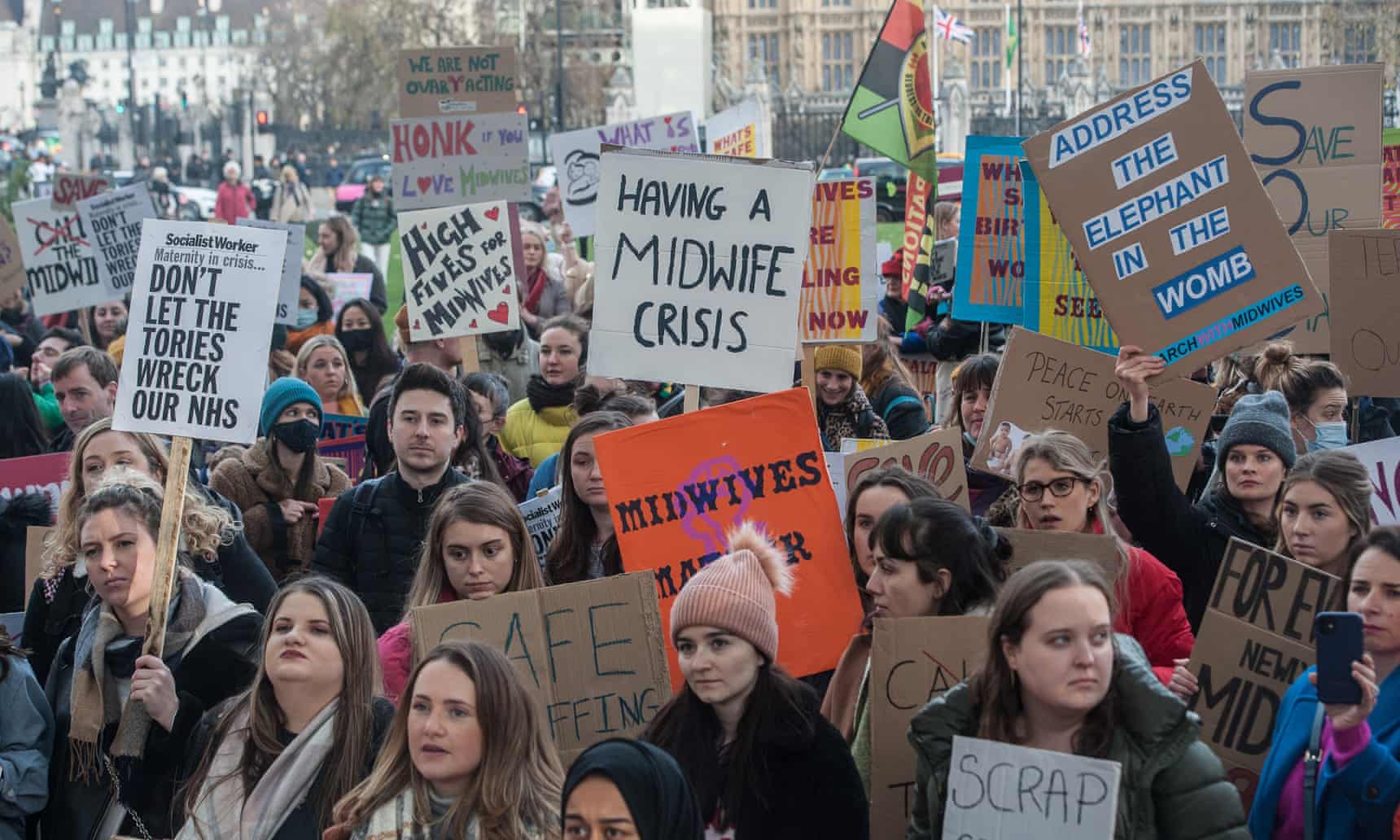
In November 2021, the RCM warned of a maternity staffing crisis. More than 57% of midwives surveyed planned to quit, citing concerns about staffing levels and fears over patient safety. “I receive messages on a daily basis from midwives,” says Leah Hazard, midwife and author of Hard Pushed: A Midwife’s Story, “who tell me they’re coming on shift and realising there aren’t enough staff to keep the workload safe.” Hazard is scathing about the £127m funding boost for NHS England maternity services, given that last year the health and social care committee determined that an annual increase of around £350m was required. “It’s insulting,” she says.
Covid has put additional strain on already stretched services. “It felt like they were so stressed,” says Marissa, a 43-year-old teacher from east London. “They just wanted to get you in and out.” Marissa became pregnant in December 2020 after eight years of trying and two previous miscarriages. Because a lockdown was in place, some midwifery appointments were by phone; at in-person appointments, she says staff appeared harried.
“There was no sense of support or concern or care,” says Marissa. “They seemed irritated and rushed.” During one appointment, Marissa says, her midwife was ordering items from Amazon on her phone. At another, Marissa asked how she should spot reduced foetal movements, but says her midwife’s response didn’t make sense. “She said: ‘Does your baby have a pattern of movement?’ I said: ‘Not really.’ She said: ‘Well, if the pattern changes, go in.’”
Marissa’s son died at 39 weeks in August 2021, after a placental abruption. She claims that hospital staff initially put her in a regular maternity ward as she waited to deliver her stillborn child. “It was horrific,” she says. “All night long I heard babies being born.” Just after giving her the news, she says that a doctor asked her whether she had had reduced movements. “It felt like he was blaming me,” she says. “His tone was accusatory. It wasn’t compassionate.” (Doctors later told Marissa that her unborn son would have died quickly in the womb, and she likely would not have noticed the reduced movements until it was too late.)
It is not only male clinicians who are to blame. “The misogyny is entrenched in the women’s behaviour as well,” says Marissa. This is ironic, since midwifery is a female-dominated profession, and also given the natural birth movement’s historical connection to second-wave feminism. The movement was “an understandable response to patriarchal control over birth”, says Eliane Glaser, author of Motherhood: A Manifesto. In the first half of the 20th century, male doctors took childbirth out of homes and into hospitals. Women were often sedated and forced to endure traumatic and unnecessary interventions.
Throughout the 60s and 70s, natural birth advocates evangelised about the empowering qualities of intervention-free childbirth, even if it was painful. “The pain of normal labour does have meaning,” writes 70s activist and US midwife Ina May Gaskin in Ina May’s Guide to Childbirth. In the UK, the movement was spearheaded by the controversial 1930s obstetrician Grantly Dick-Read, who argued that “healthy childbirth was never intended by the natural law to be painful”. Rather, he suggested that educated women experience pain as a result of fear, and they should look to their “primitive” sisters in the developing world, who are unburdened by this anxiety. “This attitude was racist to non-white women,” says Glaser. “And it’s also an anti-feminist attack on educated women.” Read More...