How to Become a Crypto Trader
-
 Loading...
 - Gathii Sikuku
- 08 Aug 2022
- 78 Views
- 0 Like
- 0 Comment
While cryptocurrency is edging closer to becoming a main stream focus of the financial world, now is a great time to determine the steps needed regarding how to become a crypto trader – and a successful one, at that.
If you have some previous experience in trading the markets, whichever instruments those may be, you are already one step ahead. Many of the standard trading guidelines apply, however, given the vast amount of volatility and hence risk involved in trading crypto CFDs, you must approach your trading strategy and risk management accordingly.
What separates a successful crypto trader from the rest? More importantly, how can you set yourself up today to become the best crypto trader possible? Find out in this guide on how to become a crypto trader.
What is a Crypto Trader?
From a basic standpoint, defining "what is a crypto trader?" is fairly simple; a crypto trader has the ultimate goal of profiting from short term changes in cryptocurrency market prices.
A crypto trader can focus on only one coin and pairing, like the infamous Bitcoin pairings - BTCUSD (or BTCEUR). Or, they may focus on multiple major coins and hence pairings, like Bitcoin and Ethereum paired with either USD or EUR.
You may have heard the terms 'alts', which means alternative cryptocurrencies and are usually considered smaller, with a market capitalisation to represent that.
Some crypto traders may focus only on alts, and not bother to train the main cryptocurrencies at all. None of the above scenarios are 'wrong' - however it is a matter of determining what is the right strategy for you, your risk tolerance, and your overall goals.
It is crucial to quickly overview the two scenarios you must consider when investigating how to become a crypto trader:
Option 1: Buy and Sell Crypto on the Exchange
It is absolutely a viable option to buy the cryptocurrency of your choice directly from a crypto exchange, which means you actually own the underlying asset of the cryptocurrency.
There are certainly advantages to this option, however those advantages are more relevant to when you want to hold the cryptocurrency for the long term – not short-term trading.
Buying and storing cryptocurrency directly on an exchange can be risky, as these exchanges can be hacked, are often (not always) unregulated, and will incur fees when you both buy and Sell – fees to the exchange.
Using this option, the trader will need to put up the full value of the position and then store the cryptocurrency in a secure wallet until they are ready to sell them at a profit or loss (it is never recommended to store crypto directly in the exchange – another reason why this option is suited for a long-term strategy).
This option is much like an investor buying a physical asset like shares of a publicly-traded company and holding them long-term in the hope that they will appreciate in value.
With cryptocurrencies, however, the volatility of price over the long-term is why many traders or investors prefer to short-term trade (compared to long-term invest).
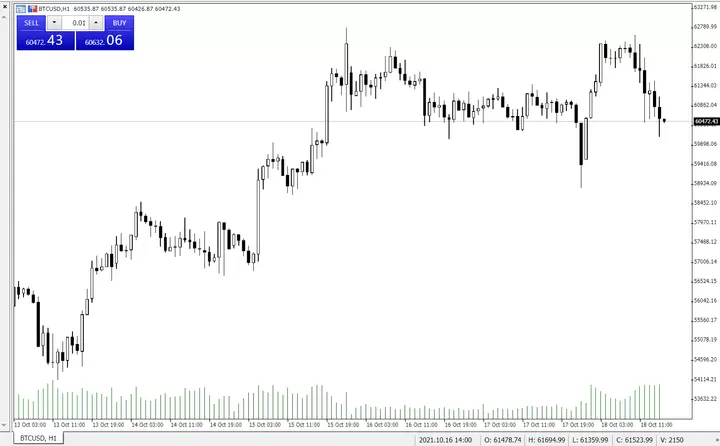
For example, the chart below shows the volatile hourly chart of Bitcoin vs the US dollar (BTCUSD):