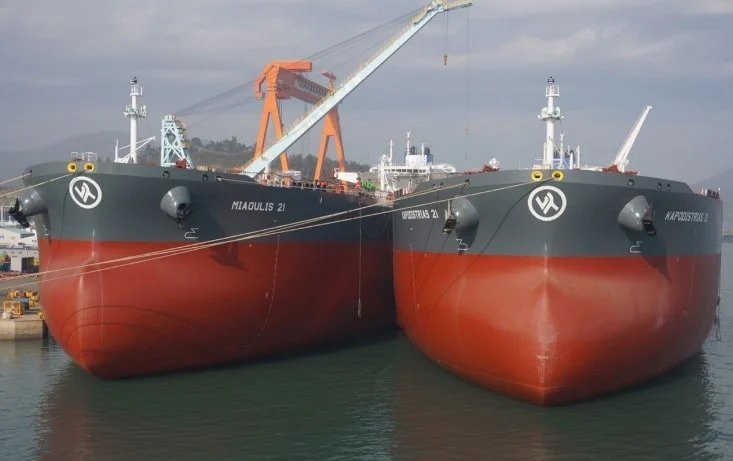
Greece Remains Top Shipping Nation in the World
-
 Loading...
 - Amon Mostafa
- 20 May 2022
- 296 Views
- 0 Like
- 0 Comment
Greece remains the top shipping nation in the world, as Greek shipowners with 5,514 ships currently control approximately 21% of the global fleet, in terms of capacity, the Union of Greek Shipowners (USG) announced in its annual report on Thursday.
According to the report, the total capacity of the Greek-owned fleet has increased by 45.8% compared to 2014, while even during the COVID-19 pandemic, i.e., since 2019, capacity rose by 7.4%.

Greece controls 59% of the EU fleet
The Greek-owned merchant fleet, which represents 59% of the European Union (EU)-controlled fleet, transports cargoes between third countries with more than 98% of its fleet capacity, thus being the world’s largest cross trader.
USG says that Greek shipping is predominantly engaged in bulk/tramp shipping, which is a truly entrepreneurial sector that maintains characteristics of perfect competition: a very large number of private, mainly small and medium-sized enterprises, compete globally for business.
The report says that Greek shipowners are constantly investing in new, energy-efficient ships and in environmentally-friendly equipment, with the average age of the Greek-owned fleet (9.99 years), being lower than the global average (10.28 years).
Newbuilding orders from Greek shipowners amount to 173 ships (from 104 ships the year before), corresponding to 17.3 million dwt3. More than one-third of the oil tankers and almost one out of six LNG carriers currently being built in the world will be delivered to Greek shipowners, it adds.
Greek shipping in an era of energy security concerns
The report says that as the EU’s energy security concerns are on the rise, Greek shipping and in particular its coal carriers, oil tankers, product tankers and LNG/LPG carriers are strategically important.
“The Greek-owned fleet secures and allows for diverse sources of energy and other essential goods imports into the EU from remote regions of the world, thereby facilitating its need to reduce its dependency on a limited number of countries.”
It notes that the EU imports 97% of its oil and petroleum products needs, 83.6% of its natural gas needs and 35.8% of its solid fossil fuels needs. Out of these, 84% of crude oil, 76% of petroleum products and 39% of LNG/LPG imports are transported by sea.
Melina Travlos, who recently became the first female President of USG, said that in the volatile global environment, “shipping has been functioning as a beacon of stability, responding to the unprecedented conditions we have been facing in the last two years due to the international health crisis, as well as due to the geopolitical crisis of recent months in Europe.”
She added that Greek shipping “has a responsibility to undertake and support initiatives, in order to inform and enlighten the wider public about the strategic importance of the industry and the need for its prioritization by the political leaders worldwide.” Read More...