German Scientists Investigate Supernova Remnant SNR G309.8+00.0 at High Energies
-
 Loading...
 - Alvin Gagne
- 17 Jul 2024
- 57 Views
- 0 Like
- 0 Comment
German astronomers, using the Spektr-RG and Fermi space observatories, have delved into the supernova remnant (SNR) G309.8+00.0. Their findings, published on the arXiv preprint server, provide significant insights into the properties of this SNR in X-ray and gamma-ray bands.
Background on Supernova Remnants
Supernova remnants are expansive, diffuse structures formed from the explosion of a star. They contain ejected material from the explosion and interstellar material swept up by the shockwave. These remnants are crucial to the evolution of galaxies, dispersing heavy elements and heating the interstellar medium. They are also believed to be a primary source of galactic cosmic ray acceleration.
Specifics of SNR G309.8+00.0
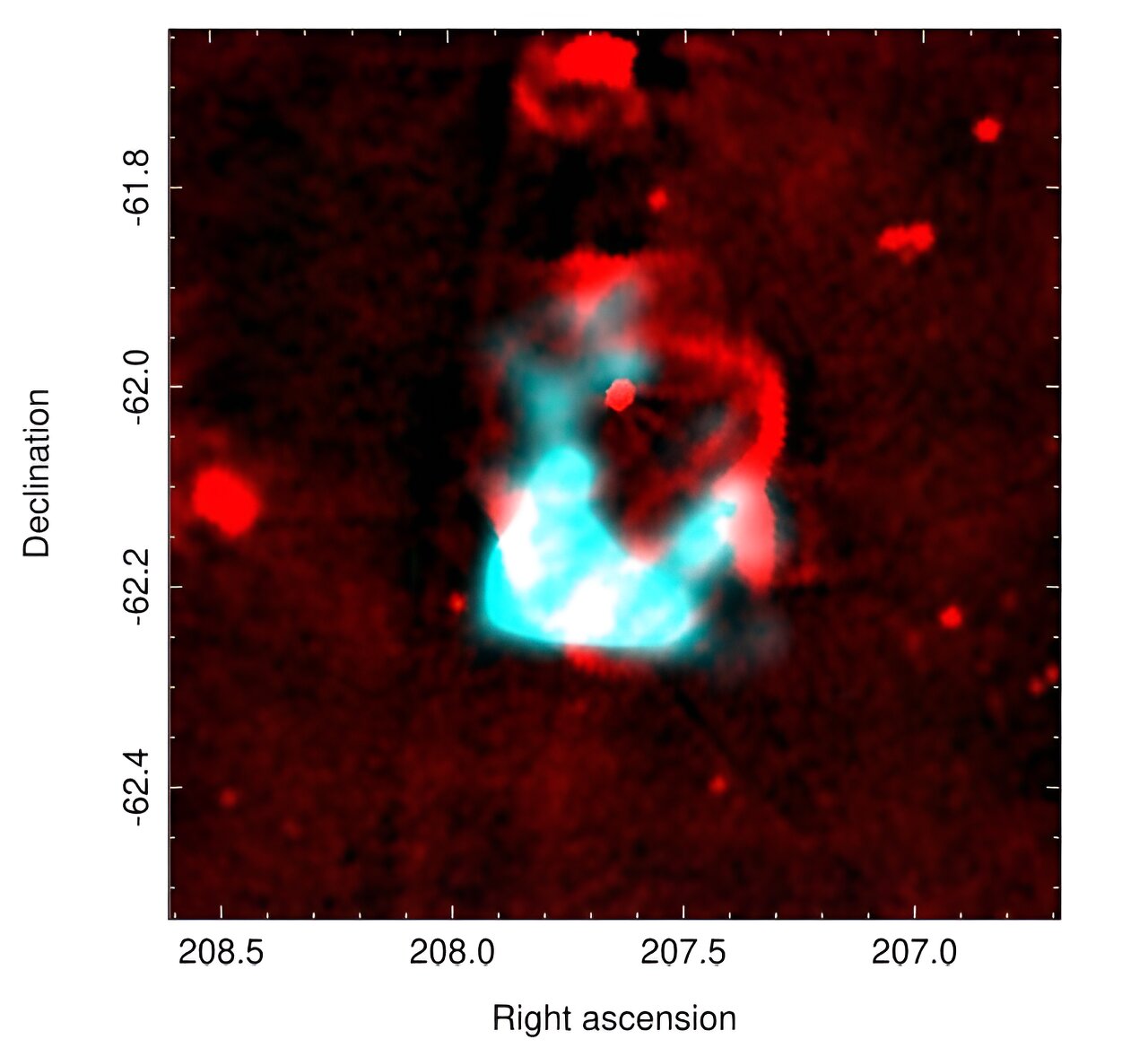
SNR G309.8+00.0, located precisely on the galactic plane, was first identified in radio wavelengths around fifty years ago. It has a well-defined elliptical shell, measuring 25 by 19 arcminutes, and is estimated to be between 10,000 and 18,000 light-years away. Despite being known for decades, it had not been detected in other wavelengths until now.
Research and Findings
The team, led by Miltiadis Michailidis from the Institute for Astronomy and Astrophysics Tübingen, aimed to study SNR G309.8+00.0 in higher energy bands—specifically X-rays and gamma rays.
X-Ray Observations:
The X-ray emission is primarily confined to the 1–2 keV energy range.
The emission has an elliptical shape, correlating well with the radio synchrotron emission of the remnant.
The X-ray emission predominantly fills the southern half of the remnant's shell.
Gamma-Ray Observations:
A significant portion of the gamma-ray emission from SNR G309.8+00.0 originates from a source labeled 4FGL J1349.5-6206c.
Further analysis decomposed this source into four point-like components, with one spatially coinciding with the shell of SNR G309.8+00.0.
Conclusion
This study represents the first exploration of SNR G309.8+00.0 at higher energy levels, providing a deeper understanding of its characteristics. The research confirms the spatial correlation between X-ray and radio emissions and identifies gamma-ray components associated with the remnant. These findings offer valuable insights into the nature of supernova remnants and their role in the cosmos.