French Painting Stolen by the Nazis Goes on Auction at Christie’s Paris
-
 Loading...
 - Atifa Fares
- 02 Dec 2024
- 67 Views
- 0 Like
- 0 Comment
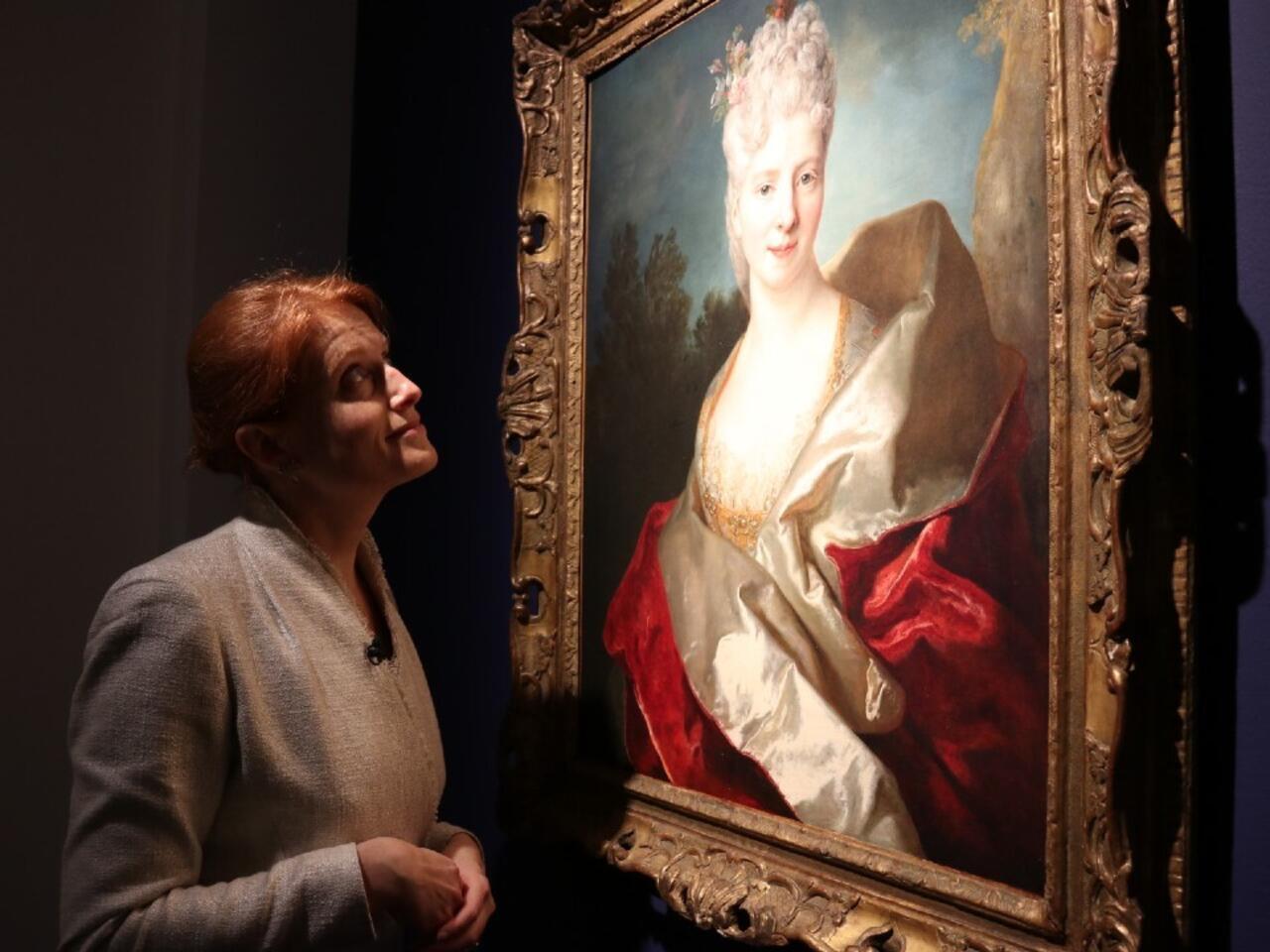
At Christie’s Paris, a unique exhibition space has been dedicated to a single painting, inviting visitors to admire the gentle, luminous features and enigmatic smile of an 18th-century woman. The artwork, titled “Portrait d'une femme, à mi-corps” (Portrait of a Woman, Mid-Body), is attributed to the French artist Nicolas de Largillierre and will be a highlight of the Old Masters auction held in November 21.
This painting is not just notable for its artistic merit; it carries a significant historical narrative, having become a symbol of Nazi-looted art. A famous photograph from May 1945 captures U.S. soldier Anthony Terra Valim holding the painting at Neuschwanstein Castle in Germany, flanked by fellow members of the Monuments Men, a group tasked with recovering art stolen by the Nazis. “It was thanks to this photo that this painting entered the public consciousness,” explains Olivia Ghosh, a Christie’s specialist in Old Master Paintings.
The painting’s journey began in the late 1930s when it belonged to Baron Philippe de Rothschild, a member of a prominent German-Jewish banking family. As tensions escalated in Europe, de Rothschild placed some of his art in safekeeping at the Société Générale bank in Arcachon, France. However, following the German invasion of France in May 1940, de Rothschild was arrested by the Vichy government, and his estate was seized, including the artworks stored at the bank.
The Nazis soon took control of these artworks, transferring them to the Jeu de Paume museum in Paris, where they were cataloged by the Einsatzstab Reichsleiter Rosenberg (ERR). Rose Valland, the museum’s head, acted as an undercover spy for the Allies, meticulously documenting the movements of looted art. She noted the inventory number "R437" associated with de Largilliere's painting, which would later prove crucial in its recovery. Her efforts ultimately guided the Monuments Men to Neuschwanstein Castle, where thousands of stolen artworks were discovered.

After the war, the painting was returned to France in November 1945 and eventually restored to de Rothschild, who had been released from the Vichy regime and had joined General de Gaulle's Free French Forces. The painting remained in private collections until 1978, when it was sold at auction to an unknown owner.
Ghosh emphasizes the painting's significance, stating, “From a historical narrative point of view, the painting has had an ideal journey.” Its well-documented provenance adds to its allure, making it a sought-after piece for collectors. Christie’s has received considerable interest in the painting, which is estimated to fetch between €50,000 and €80,000, though auctioneers believe it could exceed this estimate due to its historical importance.
The auction also highlights broader issues surrounding Nazi-looted art. Ghosh notes that at every auction, there are often paintings that may have been stolen, and Christie’s maintains a dedicated restitution department to address these concerns. In 1998, a landmark conference on Nazi-confiscated art established principles to help resolve issues related to looted art, leading to a wave of restitutions that continues today.
Christie’s is also honoring Rose Valland by timing the sale of de Largilliere’s painting with the first English-language publication of her book, “The Art Front,” originally released in 1961. The book, translated by historian Ophélie Jouan, will be launched in New York in early December.
As the auction approaches, the portrait’s enigmatic subject continues to captivate historians and art enthusiasts alike. Ghosh believes the painting still holds secrets waiting to be uncovered: “She is someone who has seen so much and who could tell extraordinary stories. You travel with her into the past, and that's what's so magical.”
With its rich history and artistic significance, “Portrait d'une femme, à mi-corps” stands as a testament to resilience, art, and the enduring power of history.