Expert unlocks mechanics of how snakes move in a straight line
-
 Loading...
 - Halle Benson
- 16 Jan 2021
- 1405 Views
- 0 Like
- 0 Comment
Snakes are known for their iconic S-shaped movements. But they have a less noticeable skill that gives them a unique superpower.
Snakes can crawl in a straight line.
University of Cincinnati biologist Bruce Jayne studied the mechanics of snake movement to understand exactly how they can propel themselves forward like a train through a tunnel.
"It's a very good way to move in confined spaces," Jayne said. "A lot of heavy-bodied snakes use this locomotion: vipers, boa constrictors, anacondas and pythons."
His study titled "Crawling without Wiggling" was published in December in the Journal of Experimental Biology.
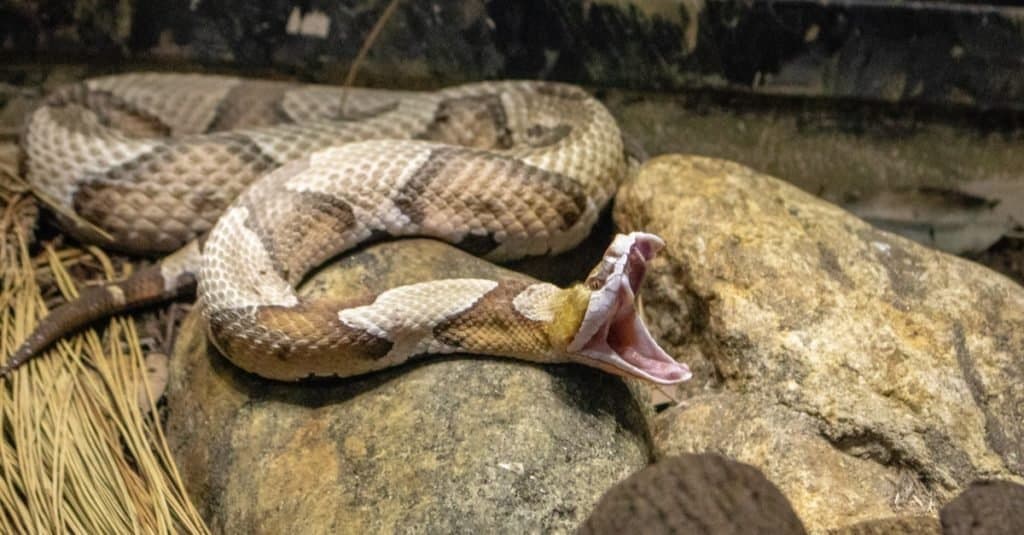
Snakes typically swim, climb or crawl by bending their spine into serpentine coils or using the leading edges to push off objects. An extreme example of their diversity of movement gives the sidewinder rattlesnake its name.
Jayne, a professor of biological sciences in UC's McMicken College of Arts & Sciences, already has unlocked the mechanics of three kinds of snake locomotion called concertina, serpentine and sidewinding. But the straightforward movement of snakes, called "rectilinear locomotion," has gotten less attention, he said.
This coordination of muscle activity and skin movement was first examined in 1950 by biologist H.W. Lissmann. He hypothesized that the snake's muscles combined with its loose, flexible and squishy belly skin enabled it to scoot forward without bending its spine.
"It's been almost 70 years without that type of locomotion being well understood," Jayne said.
Jayne and his graduate student and co-author, Steven Newman, tested Lissmann's hypothesis using equipment unavailable to researchers in the 1950s. Jayne used high-definition digital cameras to film boa constrictors while recording the electrical impulses generated by particular muscles. This produced an electromyogram (similar to an EKG) that showed the coordination between the muscles, the snake's skin and its body.
For the study, Newman and Jayne used boa constrictors, big-bodied snakes known for traveling in a straight line over the forest floor. They recorded high-definition video of the snakes moving across a horizontal surface hashed with reference marks. The researchers also added reference dots on the sides of the snakes to track the subtle movement of their scaly skin.
When the snake inches forward, the skin on its belly flexes far more than the skin over its ribcage and back. The belly scales act like treads on a tire, providing traction with the ground as the muscles pull the snake's internal skeleture forward in an undulating pattern that becomes fluid and seamless when they move quickly.
The snake's muscles are sequentially activated from the head toward the tail in a remarkably fluid and seamless way. Two of the key muscles responsible for this extend from the ribs (costo) to the skin (cutaneous) giving them their name costocutaneous.
"The vertebral column moves forward at a constant rate," Newman said. "One set of muscles pulls the skin forward and then it gets anchored in place. And opposite antagonistic muscles pull on the vertebral column."
The advantage of this kind of motion is obvious for a predator that eats rodents and other animals that spend time underground.
"Snakes evolved from burrowing ancestors. You can fit in much narrower holes or tunnels by moving this way than if you had to bend your body and push against something," Newman said.
The study was supported in part by a grant from the National Science Foundation.
Jayne said Lissmann's 1950 description largely was correct.
"But he hypothesized that the muscle that shortens the skin was the mechanism that propels a snake forward. He got that wrong," Jayne said. "But given the time he conducted the study, I marvel at how he was able to do it. I have tremendous admiration for his insights."
Industry has tried to mimic the limbless, serpentine movements of snakes in robots that can inspect pipelines and other underwater equipment. Newman said robots that can harness a snake's rectilinear motion could have profound applications.
"This research could inform robotics. It would be a big advantage to be able to move in straight lines in small, confined spaces. They could use snake-like robots for search-and-rescue in debris and collapsed buildings," Newman said.
Rectilinear locomotion is low gear for snakes that otherwise can summon surprising speed. They only use it when they are relaxed. The researchers observed that snakes reverted to traditional concertina and serpentine motions when they were startled or prodded to move.
An avid cyclist, Jayne has studied the physiology and biomechanics of cycling in a lab in Rieveschl. He has ongoing studies of riders' cardiovascular fitness. He measures their oxygen consumption in one minute per kilogram of body weight to learn more about how cyclists can increase their muscles' ability to burn lactase.
But he has always been most fascinated by snakes. His work has been published in more than 70 journal articles, most of them examining some aspect of snake behavior or biology. Most recently, Jayne has studied snake locomotion, particularly the amazing ability of some to climb trees.
Jayne teaches vertebrate zoology and human physiology and biomechanics at UC.
Jayne's lifelong interest in snakes has given science keen insights into many previously undocumented behaviors. He studied crab-eating snakes in Malaysia and is testing the acuity of snake vision in his own makeshift optical lab at UC.
By testing the limits of its mobility, Jayne can learn more about the snake's complex motor controls. This can shed light on how humans can execute coordinated movements.
"What allows them to go in all these different directions and deal with all of that three-dimensional complexity is they have a diversity or plasticity of neural control of the muscles," Jayne said. "Even if the animal had the physical strength to do something, it wouldn't necessarily have the neural control."
Jayne wants to learn more about how this refined motor control contributes to a snake's amazing contortions.
"They move in so many fascinating ways. Is that because they have such an incredible diversity of motor patterns that the nervous system can generate?" he said.
"Even though all snakes have the same body plan, there are fully aquatic snakes, snakes that move on flat surfaces, snakes that move in a horizontal plane, snakes that climb. They go everywhere," he said. "And the reason they can go everywhere is they have so many different ways of controlling their muscles. That's pretty intriguing."
Four Types of Snake Movement:
Serpentine: Also called lateral undulation, this is the typical side-to-side motion used by snakes over rough ground or in the water.
Concertina: Snakes coil into alternating curves before straightening themselves to propel themselves forward.
Sidewinding: Snakes bend in waves both side to side and in a vertical plane to lift the body to form just a few contact points with the ground. This helps rattlesnakes traverse hot sand or climb dunes.
Rectilinear: Specialized muscles move the belly skin of a snake, propelling it forward in a straight line. This allows snakes to slip through burrows not much bigger than they are.