Egypt's first pharaohs loved catfish—and worshipped them
-
 Loading...
 - Sadiki Omar
- 19 Sep 2022
- 65 Views
- 0 Like
- 0 Comment
Cobras, cats, and vultures are among the most popular animals depicted in ancient Egyptian art, but the humble catfish once dominated the iconography of the civilization by the Nile. Common to every continent except Antarctica, catfish are the most diverse group of fish on earth. The 2,000 to 3,000 species have some remarkable characteristics, so it is little wonder they attracted the attention of the Egyptians, one of the most animal-conscious ancient cultures.
Named for its feline-like whiskers, called barbels, a catfish has finely honed senses that allow it to survive and find food in murky, muddy waters. One family of catfish has a respiratory system that allows it to use atmospheric oxygen. This is most spectacularly employed by the walking catfish (Clarias batrachus), familiar today as an invasive species in Florida, which uses its fins to waddle over land.
The ancient Egyptians had intimate knowledge of the several species of catfish that they observed among the rich life of the Nile River. Individual species are often clearly identifiable in Egyptian art and iconography.
Egyptians attributed rich symbolic and mythological roles to the catfish. The upside-down catfish (Synodontis batensoda), for example. was imbued with symbolic importance. Its “flipped” orientation allows it to position its mouth close to the water’s surface, from where it appears to be swimming upside down. Belly-up on the surface, it appeared dead but was clearly alive, suggesting powers of regeneration.
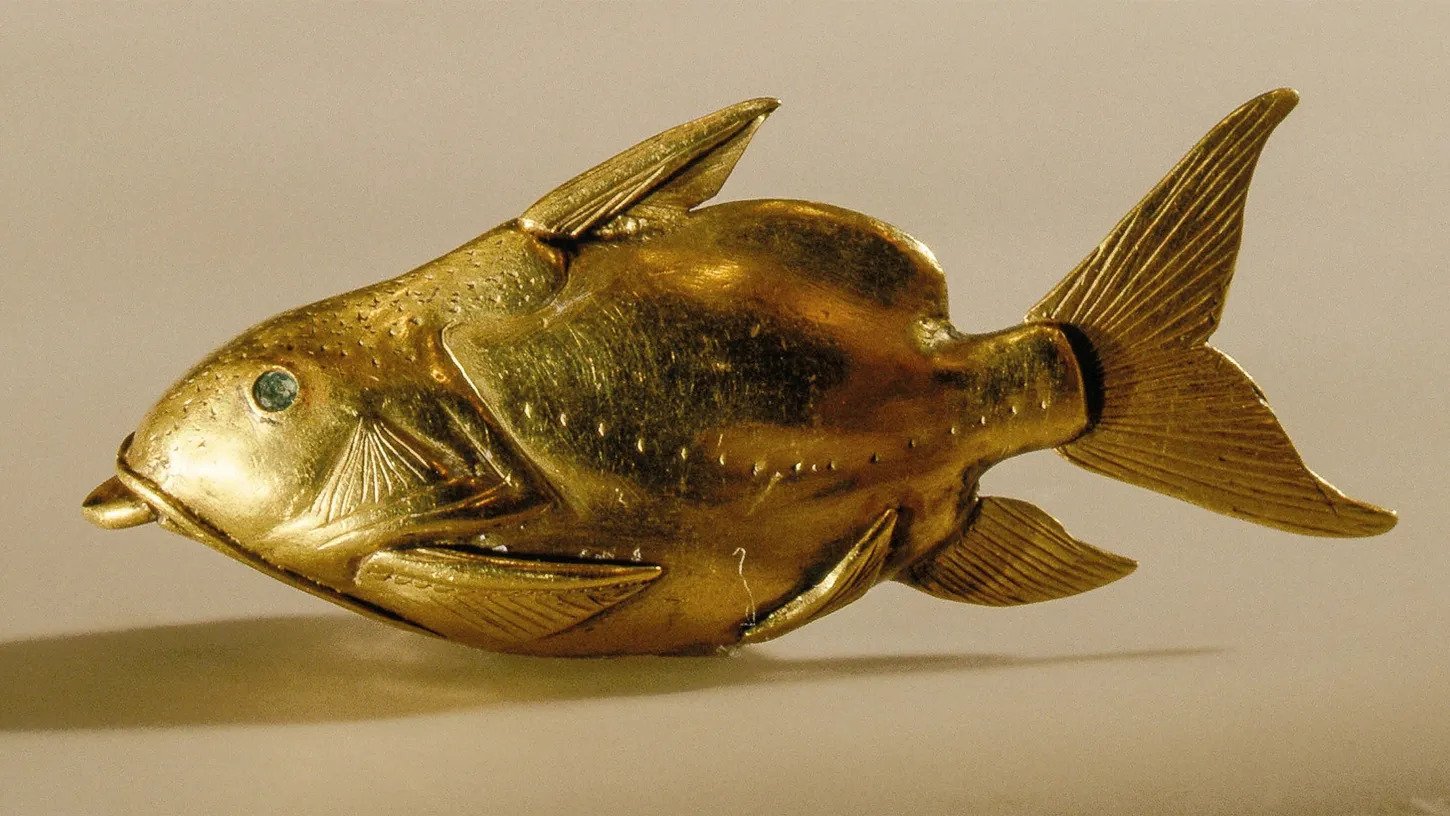
Amulets of these creatures have been found throughout Old and Middle Kingdom sites in Egypt. These objects, it was believed, prevented drowning and were worn as necklaces or as hair ornaments. One gold pendant from the early second millennium B.C. is so naturalistic, it can be easily identified as the upside-down catfish. Read More...