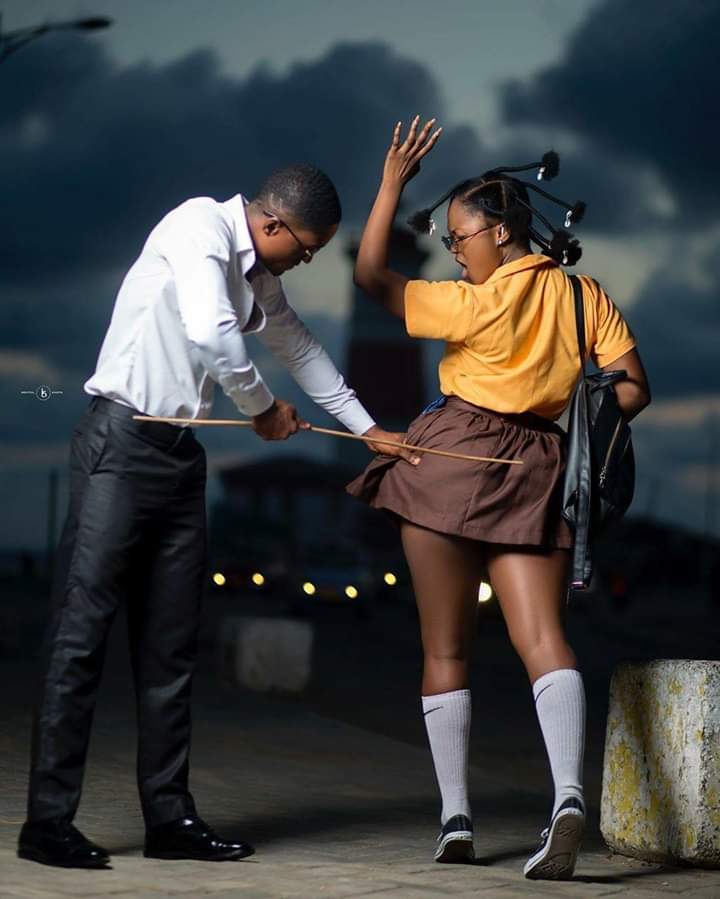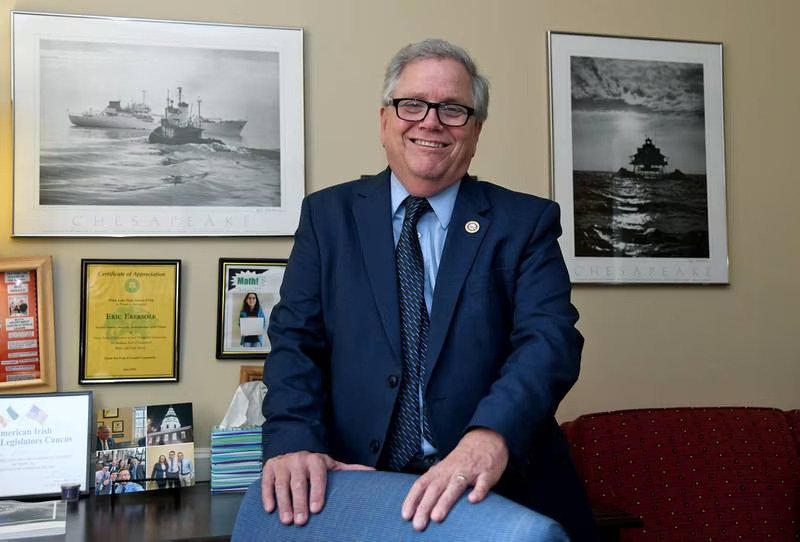
Corporal punishment is legal in some Maryland schools. An author and her state delegate spouse want to change that.
-
 Loading...
 - Kuntum Chua
- 27 Feb 2023
- 68 Views
- 0 Like
- 0 Comment
Catonsville author Tara Ebersole’s first foray into fiction writing drew her deep into researching corporal punishment in education. She was stunned to discover the practice is still legal in some settings in Maryland.
Although corporal punishment cannot be administered to a public school student in Maryland, the law is largely silent on its use in other institutions, such as private schools, nonpublic schools and schools operated by religious organizations.
Ebersole, now a Community College of Baltimore County professor, started her research while mining her early experiences as a teacher for her first novel. When she taught at a public junior high school in Tennessee, she was required to use a 2-foot wooden paddle on students. She planned to weave facts into the story that might prompt a casual reader to rethink the merits of physically disciplining children.
Ebersole mentioned her discovery regarding Maryland law to her husband, Democratic Del. Eric Ebersole of Baltimore County, who echoed her shock.
“‘You’ve got to be kidding me,’” she recalled he said.
The revelation kicked off their effort this legislative session to close a loophole in Maryland code that still permits corporal punishment of some students.
House Bill 185, introduced by Del. Ebersole, would order the Maryland Department of Education to eliminate any use of corporal punishment in schools and would explicitly prohibit it in nonpublic schools and registered family child care homes. It would bar the State Board of Education from certifying any noncollegiate educational institution that lacks a policy banning the practice.
The House passed the bill Thursday and it’s now being considered by a Senate committee.
It’s attracted about a dozen co-sponsors and garnered favorable testimony from the Maryland Psychological Association, Free State PTA, the Women’s Law Center of Maryland, Disability Rights Maryland, Maryland Family Network, Strong Schools Maryland, the Maryland Developmental Disabilities Council, Secular Maryland, the Maryland State Education Association, the state’s chapter of National Association of Social Workers and the Kennedy Krieger Institute in Baltimore.
Maryland law favors disciplining students with behavioral interventions, restorative approaches, counseling, and meetings with parents and students. Schools may also suspend and expel students. And state regulations involving younger children already prohibit child care providers, employees and volunteers from spanking, hitting, shaking or using any other means of physical discipline. Read More…