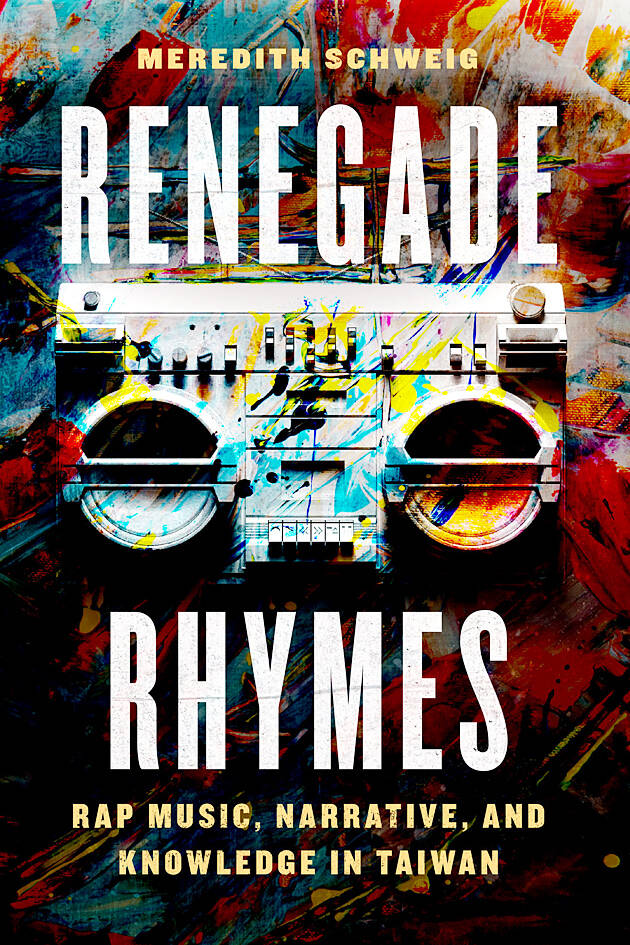
Book Review: Unveiling the Vibrant Tapestry of Taiwanese Hip-Hop

In this captivating book, the rich origins and remarkable linguistic wordplay of Taiwanese rap music are explored, shedding light on a genre that has captivated audiences with its ingenuity. Despite my deep appreciation for golden age hip-hop and the privilege of interviewing esteemed figures from that era, such as Public Enemy, Ice T, and DJ Premier, during my early years in Taiwan, my familiarity with Taiwanese rap remains limited.
My exposure to Taiwanese rap was confined to a few encounters: witnessing MC Hot Dog open for Missy Elliot in 2006, unknowingly experiencing Dwagie (大支) as an opening act for Wu-Tang Clan's Raekwon and Ghostface in 2014, and stumbling upon LA Boyz in my ex-brother-in-law's dusty CD collection back in 2002, a fleeting encounter that left me unimpressed. The repetitiveness of the beats and the raucousness of the rappers' delivery overshadowed any potential appreciation, primarily due to the language barrier.
Even if I had possessed the language proficiency to decipher a rhyme or two, the Taiwanese emcees' fondness for multilingual homophonic punning would have undoubtedly left me bewildered. It is, therefore, fitting that a significant portion of this book delves into the pedagogic role that rap has played for young men in Taiwan. The sections that dissect intricate wordplay inspired me to seek out the tracks in question, attempting to grasp the lyrical prowess on display.
By deconstructing verses from Taiwan's most gifted wordsmiths, the author showcases how Mandarin and Hoklo (also known as Taiwanese) are skillfully employed to enhance what the late Adam Krims, a pioneering scholar of hip-hop, termed a "percussion-effusive flow." This term refers to the utilization of intricate rhyme schemes where lines transcend the rhythmic boundaries of the meter, resulting in polyrhythms achieved through beat subdivision, syntax and rhyme staggering, off-beat accents, and other techniques. The vocal delivery creates a percussive quality, giving the impression that the MC is wielding their voice as a musical instrument.
A notable example is Dwagie's 2002 track, "Forty-Four Fours" (四十四個四, sishisi ge si). Interestingly, Jay-Z released a tune with the same title a few years later, also employing homophonic punning. Was this a unique instance of an American rap star drawing inspiration from a Taiwanese emcee? "Dwagie's adeptness in percussion effusiveness," Schweig writes, "benefits greatly from Mandarin's exceptional potential for homophonic punning..."
The subsequent exposition masterfully unravels the intricacies of this technique. The author presents Dwagie's verses in traditional Chinese characters, followed by Hanyu pinyin, and finally, an English translation. In her introductory note on romanization and translation, she clarifies that the English lyrics do not strive to maintain the original-language texts' rhythm or rhyme but rather aim to convey their meaning, tone, and emphasis.
As the title suggests, "Forty-Four Fours" plays with homophones for the syllables "si" and "shi." The latter syllable alone appears 19 times in seven different characters across the first four lines. Additionally, internal rhymes employing the similar-sounding syllable "zhi" are employed. However, it is not the rhyming of the final emphasized vowel sounds that captivates the listener but rather the clever allusion to Taiwanese speakers of Mandarin and Hoklo merging alveolar (s) and retroflex (sh, zh) sibilants in initial conson ants. This self-deprecating humor, as Schweig points out, brings to mind the music of Jutoupi (豬頭皮), an unexpected pioneer of Taiwanese rap. Initially a folk singer-songwriter in the early 1990s, Jutoupi, whose real name is Chu Yueh-hsin (朱約信), was enlisted by Ni Chong-hua (倪重華), the record executive behind the success of Taiwanese-American pop-rap trio LA Boyz. (Ni went on to lead MTV Taiwan and, more recently, faced controversy before resigning from his position as cultural commissioner for Taipei City in 2015.)
Initially hired as a lyricist, Chu eventually developed his eccentric Jutoupi alter ego as a platform for unconventional content that didn't fit the mold of Ni's other project, The Party. In his 1994 release, "Taiwan Language Battle," Jutoupi portrays multiple characters in snippets of dialogue supposedly overheard during his strolls around Taipei. These humorous exchanges are based on mispronunciations by Taiwanese speakers of Mandarin and Japanese individuals conversing in heavily accented English. In one instance, a student asks a classmate, "How old are you?" (同學你幾歲?) only to receive the comical response, "That's my foot bath water" (我洗腳水啦) — a playfully Hoklo-inflected mispronunciation of "I'm 19 years old."
Schweig, along with her interviewees, including Jutoupi himself, trace this style of "rapped" dialogue set to music back to the liamkua (唸歌) folk tradition. In this tradition, performers recite verses in a song or spoken-word format, adopting various voices and pitches, often accompanied by a moon lute (yueqin, 月琴). Another traditional art form briefly mentioned by rapper Manchuker (滿人) is xiangsheng. From the perspective of comical miscommunication, xiangsheng appears to have exerted significant influence.
However, liamkua is identified as one of the three inspirations behind Taiwanese rap, alongside xiha (嘻哈), a transliteration of "hip-hop" that refers to a black- and Latin-influenced "composite hip-hop culture" introduced to Taiwan from the United States in the 1980s, and raoshe (饒舌), which Schweig translates as "rhapsodizing tongue." This latter strand, demanding verbal dexterity, is associated with politically astute musicians who, after the end of martial law, were among the first to experiment with rap in Mandarin and Hoklo. Throughout the book, Schweig delves into hip-hop in Taiwan as a vehicle for knowledge exchange. It's remarkable how many prominent figures in the scene have received extensive education, with several holding doctorates or postgraduate degrees, while even those without formal qualifications tend to come from reputable universities and high schools. Through workshops, online forums, and lectures, these elder statesmen have nurtured a new generation of politically aware b-boys (and, as Schweig astutely observes, this scene is predominantly male, often preoccupied with projecting machismo).
While some aspects of Taiwanese hip-hop identified by Schweig may not seem uniquely cultural, there is enough substance to provide a glimpse into an art form and cultural movement that has solidified its distinct identity. Renegade Rhymes, based on over a decade of research and fieldwork, explores a wide range of sociopolitical themes. It would be a disservice if its readership were limited solely to diehard hip-hop enthusiasts.