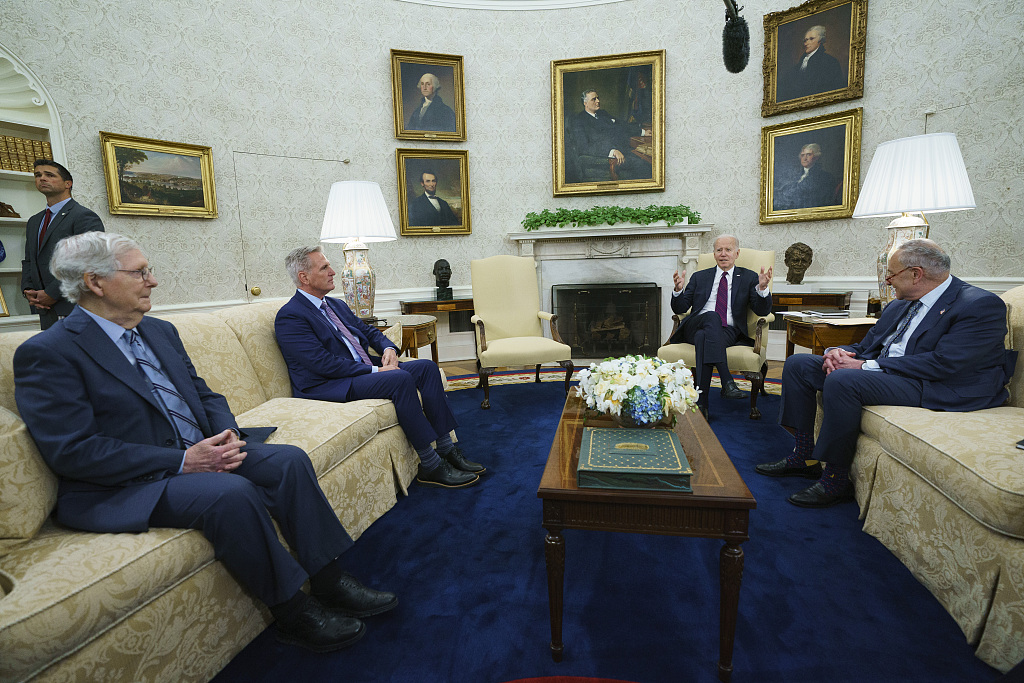
Biden, McCarthy divided over debt ceiling but talks continue
-
 Loading...
 - Daiyu Xiao
- 10 May 2023
- 61 Views
- 0 Like
- 0 Comment
The United States is currently facing a major challenge - the debate over the national debt ceiling. Democrats and Republicans have been at odds over the issue for years, and the current situation is no different. President Joe Biden and House Minority Leader Kevin McCarthy are the key players in the ongoing debate. This article will take a closer look at the issue, the stance of both parties, and the possible outcomes.
The national debt ceiling is the maximum amount of money that the federal government can borrow to fund its operations. It is determined by Congress and has been a subject of much debate over the years. Currently, the debt ceiling stands at $28.4 trillion, and the U.S. government is set to run out of funds by October 2021. Failure to raise the debt ceiling could have catastrophic consequences for the U.S. economy and global financial markets.
Biden, McCarthy Divided Over Debt Ceiling But Talks Continue
President Biden and House Minority Leader McCarthy have taken opposing positions on the debt ceiling debate. Biden and other Democrats have called for a clean bill to raise the debt ceiling, while McCarthy and his fellow Republicans have demanded that Democrats attach spending cuts to any legislation raising the debt ceiling.
Biden has accused the Republicans of playing politics with the issue and has warned of the consequences of not raising the debt ceiling. He has stated that the U.S. cannot default on its debts, and failure to raise the debt ceiling would cause chaos in the financial markets, hurt the U.S. economy, and lead to a downgrade of the country's credit rating.
McCarthy has argued that the Democrats are using the debt ceiling as an excuse to pass their agenda without Republican support. He has called on the Democrats to come to the negotiating table and to work out a compromise that includes spending cuts. McCarthy has stated that the U.S. cannot continue to borrow money without any consequences and that Republicans are willing to work with Democrats to find a solution.
The Stance of Both Parties
The current debate over the debt ceiling is just the latest in a series of showdowns between the two parties. Democrats have historically been more willing to raise the debt ceiling without any conditions, while Republicans have sought to attach spending cuts or other conditions to any legislation raising the debt ceiling.
Democrats argue that the debt ceiling is an arbitrary limit that should be raised to meet the government's funding needs. They point out that the U.S. has never defaulted on its debts and that failure to raise the debt ceiling could have catastrophic consequences.
Republicans, on the other hand, argue that the debt ceiling is a necessary check on government spending and that the U.S. cannot continue to borrow money without any consequences. They have called for spending cuts or other conditions to be attached to any legislation raising the debt ceiling.
Possible Outcomes
The debt ceiling debate is far from over, and the possible outcomes are uncertain. The most likely scenario is that the Democrats will pass a clean bill to raise the debt ceiling without any conditions attached. However, this could prove difficult if Republicans filibuster the bill in the Senate.
Another possible outcome is that Democrats and Republicans will come to a compromise that includes spending cuts or other conditions. This would require both parties to make concessions and could prove difficult in the current political climate.
Finally, if the debt ceiling is not raised, the U.S. government could default on its debts. This would have catastrophic consequences for the U.S. economy and global financial markets.
FAQs
Q: What is the national debt ceiling?
A: The national debt ceiling is the maximum amount of money that the federal government can borrow to fund its operations.
Q: Why is there a debate over the debt ceiling?
A: There is a debate over the debt ceiling because Democrats and Republicans have different views on how to handle the U.S. government's borrowing and spending habits.
Q: What is the current stance of President Biden on the debt ceiling?
A: President Biden has called for a clean bill to raise the debt ceiling without any conditions attached.
Q: What is the current stance of House Minority Leader McCarthy on the debt ceiling?
A: House Minority Leader McCarthy has called for spending cuts or other conditions to be attached to any legislation raising the debt ceiling.
Q: What happens if the debt ceiling is not raised?
A: If the debt ceiling is not raised, the U.S. government could default on its debts, which would have catastrophic consequences for the U.S. economy and global financial markets.
Q: Can the debt ceiling be raised without any conditions attached?
A: Yes, the debt ceiling can be raised without any conditions attached if the Democrats are able to pass a clean bill.
Q: What is the most likely outcome of the debt ceiling debate?
A: The most likely outcome is that the Democrats will pass a clean bill to raise the debt ceiling without any conditions attached.