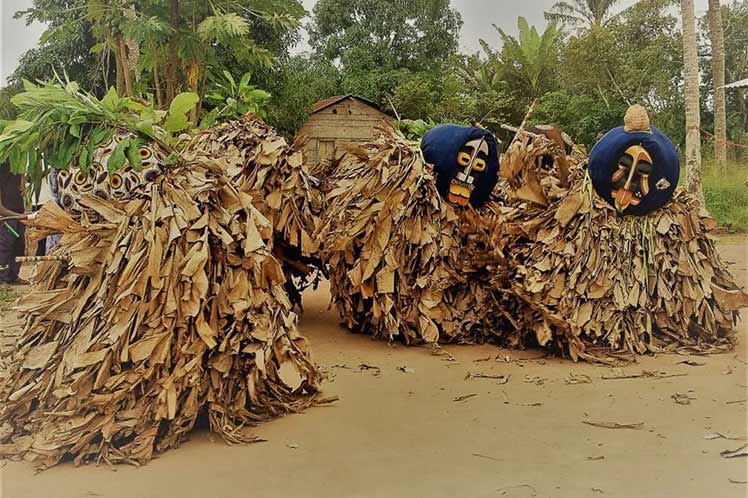
Angola: The Bakama

From ancient times, every once in a while public interest in masks and costumes in parties and mourning ceremonies emerge over and over again; however, the bakama of Cabinda, in northern Angola, maintain their secrets.
Records on the origin, meaning and symbolic power of these groups come from spoken history, experts say, such as Miguel Raul Mazissa, whose doctor’s dissertation dealt with the forms in which the traditional culture of Cabinda is represented.
However, none reveals the inner content of rituals, in which only the initiated can participate, the researcher said.
Group members take part in funerals, purification parties, thanksgivings and other celebrations, always covered with masks, dried banana leaves and cloth scraps, never revealing the bearer’s true identity.
The tradition’s emergence is linked to the Bawoio ethnic group, according to ethnographic research conducted in cooperation with members of the Bakama organizations of Tchizo, Susso and Pueblo Grande, and the Zindunga of Chinzazi and Ngoio.
According to Mazissa, the word “bakama” comes from the ethnic and linguistic symbols of Cabinda’s Woio, in which to designate a woman as belonging to a man they needed to use the term “nkama” in singular, and “bakama” in plural, the two of Bantu origin.
The association’s mythological foundations are based on the deity Lusunzi, represented by 11 female masks; however, the entity does not foresee that women join the group as effective members: adults only play the role of cooking in ceremonies and educating children as part of cultural rules.
Legend has it that mermaid Lusunzi lived in a forest, not in the sea. She had two faces, one was black and the other one was white. She was the daughter of Mbonze, who lived in the waters of a small lake called Luozi in the Yabi plains, south of Cabinda, historian João Cláudio do Nascimento Gime explained. Read More...