A microbe's membrane helps it survive extreme environments
-
 Loading...
 - Maya Conte
- 06 Dec 2021
- 909 Views
- 0 Like
- 0 Comment
Within harsh environments like hot springs, volcanic craters and deep-sea hydrothermal vents -- uninhabitable by most life forms -- microscopic organisms are thriving. How? It's all in how they wrap themselves.
Stanford University researchers have identified a protein that helps these organisms form a protective, lipid-linked cellular membrane -- a key to withstanding extremely highly acidic habitats.
Scientists had known that this group of microbes -- called archaea -- were surrounded by a membrane made of different chemical components than those of bacteria, plants or animals. They had long hypothesized that it could be what provides protection in extreme habitats. The team directly proved this idea by identifying the protein that creates the unusual membrane structure in the species Sulfolobus acidocaldarius.
The structures of some organisms' membranes are retained in the fossil record and can serve as molecular fossils or biomarkers, leaving hints of what lived in the environment long ago. Finding preserved membrane lipids, for example, could suggest when an organism evolved and how that may have been the circumstance of its environment. Being able to show how this protective membrane is created could help researchers understand other molecular fossils in the future, offering new evidence about the evolution of life on Earth. The results appeared the week of Dec. 3 in Proceedings of the National Academy of Sciences.
"Our model is that this organism evolved the ability to make these membranes because it lives in an environment where the acidity changes," said co-author Paula Welander, an assistant professor of Earth system science at Stanford's School of Earth, Energy & Environmental Sciences (Stanford Earth). "This is the first time we've actually linked some part of a lipid to an environmental condition in archaea."
Rare chemistry
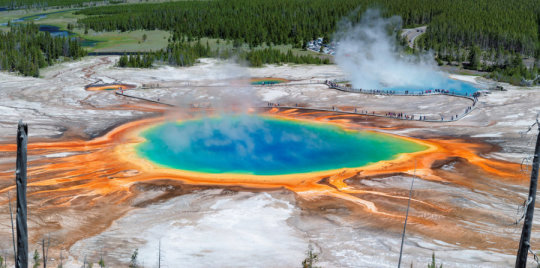
The hot springs where S. acidocaldarius is found, such as those in Yellowstone National Park that are over 200 degrees Fahrenheit, can experience fluctuating acidity. This organism is also found in volcanic craters, deep-sea hydrothermal vents and other acidic environments with both moderate and cold temperatures.
Welander became interested in studying this microbe because of its rare chemistry, including its unusual lipid membranes. Unlike plants and fungi, archaeal organisms do not produce protective outer walls of cellulose and their membranes do not contain the same chemicals as bacteria. Scientists had explored how the species produced its unusual membrane for about 10 years before experimentation stopped in 2006, she said.
"I think we forget that some things just haven't been done yet -- I've been finding that a lot ever since I stepped into the geobiology world," Welander said. "There are so many questions out there that we just need the basic knowledge of, such as, 'What is the protein that's doing this? Does this membrane structure really do what we're saying it does?'"
From previous research in archaea, Welander and her team knew that the organisms produce a membrane containing a ringed molecule called a calditol. The group thought this molecule might underlie the species' ability to withstand environments where other organisms perish.
To find out, they first went through the genome of S. acidocaldariusand identified three genes likely to be involved in making a calditol. They then mutated those genes one-by-one, eliminating any proteins the genes made. The experiments revealed one gene that, when mutated, produced S. acidocaldarius that lacked calditol in the membrane. That mutated organism was able to grow at high temperatures but withered in a highly acidic environment, suggesting that the protein is necessary to both make the unusual membrane and withstand acidity.
The work was particularly challenging because Welander's lab had to replicate those high temperature, acidic conditions in which the microbes thrive. Most of the incubators in her lab could only reach body temperature, so lead author Zhirui Zeng, a postdoctoral researcher in Welander's lab, figured out how to imitate the organism's home using a special small oven, she said.
"That was really cool," Welander said. "We did a lot of experimenting to try to figure out the chemistry."
Third domain of life
This work is about more than just finding one protein, Welander said. Her research explores lipids found in present-day microbes with the goal of understanding Earth's history, including ancient climatic events, mass extinctions and evolutionary transitions. But before scientists can interpret evolutionary characteristics, they need to understand the basics, like how novel lipids are created.
Archaea are sometimes called the "third domain of life," with one domain being bacteria and the other being a group that includes plants and animals -- collectively known as eukaryotes. Archaea includes some of the oldest, most abundant lifeforms on the planet, without which the ecosystem would collapse. Archaea are particularly anomalous microbes, confused with bacteria one day and likened to plants or animals the next because of their unique molecular structures.
The research is particularly interesting because the classification for archaea is still debated by taxonomists. They were only separated from the bacteria and eukaryote domains in the past two decades, following the development of genetic sequencing in the 1970s.
"There are certain things about archaea that are different, like the lipids," Welander said. "Archaea are a big area of research now because they are this different domain that we want to study, and understand -- and they're really cool."


